Some discoveries are made by finding something. Others are made by noticing what is missing.
During a recent cemetery-hunting trip through Pennsylvania, Maryland, and Ohio, I visited numerous burial grounds connected to my husband's Harbaugh family and my own Duer ancestors. Some visits led to new discoveries. Others answered long-standing questions.
One stop left me with neither.
Instead, it left me staring at several empty spaces in a family burial plot and wondering whether the answers had been there all along.
For years, I have searched for the final resting places of Elias Harbaugh and his wife, Mary Magdaline Weaver Harbaugh.
Elias presents a challenge because his probate file no longer exists in Franklin County, Pennsylvania. Based on surviving records, he likely died about 1874. Mary appears to have died around March 1877, her death inferred from a deed recorded by her grandson, George Henry, in 1885.
Like many genealogists, I have spent years piecing together fragments of evidence to reconstruct their lives. What I hoped this trip would provide was something more tangible. A tombstone. A burial record. Some confirmation of where they were laid to rest.
For a long time, I have suspected that Elias and Mary were buried in Antietam Church Cemetery in Waynesboro, Franklin County, Pennsylvania.
The theory is not without support. Their only child who remained in Pennsylvania, Frederick Alexander Harbaugh, was buried there in 1894. The cemetery contains several members of Frederick's family, suggesting that the Harbaughs used this churchyard for multiple generations.
Ten years ago, I spoke with the church minister regarding burial records. Unfortunately, the surviving records do not extend back to the 1870s. If documentation once existed identifying Elias and Mary's graves, it has not survived.
Still, I hoped the cemetery itself might provide clues. Cemeteries often tell stories that records cannot.
Families were frequently buried together. Parents, children, spouses, and siblings often occupied adjoining plots. Even when records disappear, burial patterns sometimes survive.
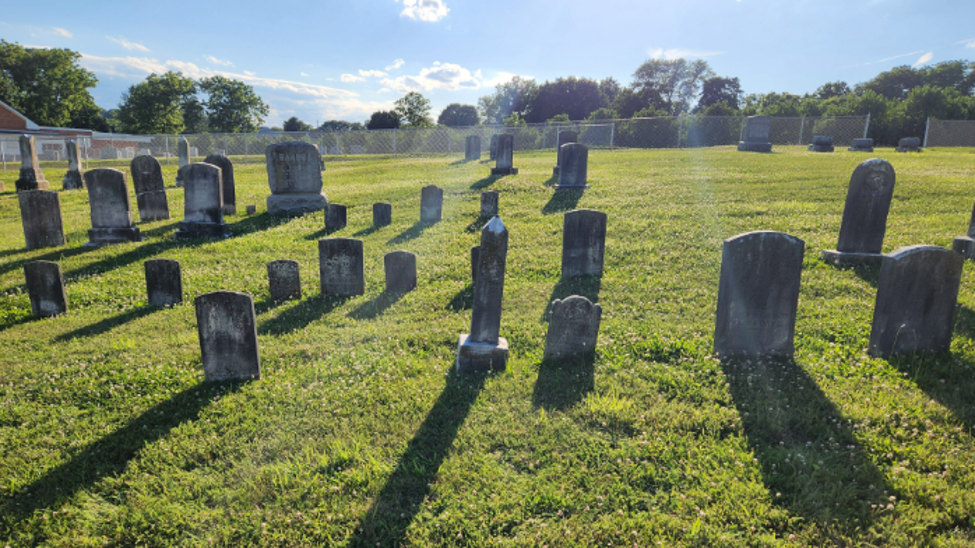
Walking among the Harbaugh stones, I was struck by how weathered many of the markers had become. Time has not been kind to them. Some inscriptions are difficult to read. Others have deteriorated significantly since photographs were taken years ago.
Yet something else caught my attention. Several empty spaces appeared within the family row. Not random gaps. Places that seemed as though stones might once have stood there.
I found myself studying the spaces as carefully as the surviving markers.
Could Elias and Mary have been buried there? Had stones once marked their graves? Were the markers lost to weather, damage, or neglect?
There was no way to know for certain.
My husband, Jim, has an uncanny ability to spot things that others miss. I hoped he might discover a sunken marker, a fragment of stone, or some overlooked clue hidden among the grass.
We searched carefully. Nothing appeared. No broken fragments. No buried marker. No evidence beyond the empty spaces themselves.
We left without answers. Yet I could not stop thinking about what those gaps represented.
Genealogists are trained to focus on evidence we can see and document. We seek records, photographs, inscriptions, and artifacts. We want proof.
But absence can sometimes be evidence, too. An empty place in a family plot may tell a story. A missing probate file may tell a story. A burial record that should exist but doesn't may tell a story.
None of these pieces alone prove that Elias and Mary rest in Antietam Church Cemetery. Together, however, they create a pattern that is difficult for me to ignore. Sometimes all that remains is a possibility.
I left Antietam Church Cemetery without finding Elias and Mary. Perhaps resting quietly among their family members, their identities lost but their presence still remembered.
Genealogy is often portrayed as a series of discoveries and breakthroughs.
In reality, much of our work involves living with uncertainty.
Not every mystery is solved. Not every ancestor leaves a marker. Not every story reaches a neat conclusion.
For now, Elias and Mary remain missing.
But every time I look at the photograph of that family row, my eyes are drawn not to the stones that remain.
They are drawn to the empty spaces and to the possibility that sometimes what is missing can tell us as much as what survives.


No comments:
Post a Comment