Friday, October 16, 2026

Hidden Way: A Genealogist's Mystery


Last October, I wrote about an extraordinary wedding record I discovered for my maternal grandmother, Mary Koss. This year, Grandma Mary, who we called Non, managed to do it again and the unsettling circumstances surrounding it make this one a perfect example of synchronicity.

In April, I contacted a Croatian court-appointed translator to handle the translation and apostille process for my family’s vital records as part of our dual-citizenship applications. The translator had originally been recommended by the Croatian consulate, and we had corresponded briefly the previous fall.

Then…nothing.

After three unanswered emails over the course of three and a half weeks, I contacted the consulate again requesting another recommendation. Their reply was brief: they were no longer providing names. After being thoroughly ghosted, I could understand why.

Fortunately, a former client who had completed the process a year earlier gave me the name of a translator in Split. The response this time was immediate and professional. The pricing was reasonable, the turnaround time was clear, and after a few emails back and forth, I sent payment through an international bank transfer.

About a week later, I received an email from DHL Express containing a waybill tracking number for the return shipment of my documents. (See above)

That’s when things became strange.

The shipment notification listed the wrong street address, the wrong zip code, and typed in ominous capital letters, the city of GARY.

I do not live in Gary, Indiana.

I’ll admit it: I panicked.

My original documents were apparently somewhere in international transit headed to the wrong place. I immediately searched online maps to see whether the mysterious street existed either in my own city or in Gary. It did not.

The zip code error at least made sense. I had accidentally mistyped it in an earlier email but quickly sent a correction afterward. The translator later admitted she had overlooked the follow-up and used the earlier message instead. That explained the zip code.

It did not explain the street name.

And it certainly did not explain GARY.

I contacted the translator, who was just as confused as I was. Her paperwork showed neither the incorrect street name nor the city of Gary. Concerned, she returned to the DHL office in person. The clerk checked their system and was equally baffled. According to DHL’s records, the strange address information simply did not exist in their computer system.

Yet it certainly existed in the email I received.

For privacy reasons, I removed the house number and waybill information from the image above, but the bizarre street name and city remain exactly as they appeared.

Sure, technology glitches happen. Addresses become corrupted. Autofill creates odd errors. But what makes this incident feel especially unsettling is the particular combination of the street name and the city itself.

My grandmother moved to Gary in 1919 as a teenage bride and lived there until 1973, when she relocated to Florida after her oldest daughter was transferred there for work. Grandma never cared much for Florida, so two years later she moved again, this time to Arizona, where her youngest daughter lived. The desert climate didn’t suit her either, and eventually she returned once more to Florida.

A few years later, she developed Alzheimer’s disease.

Her children had promised they would never place her in a nursing home, so she moved in with her middle daughter in Pennsylvania. When that daughter became ill, Grandma was relocated once again to Arizona, where her youngest daughter left her job to care for her full time.

Grandma died in Arizona.

But her body was brought home for burial in, you guessed it, Gary.

As for the mysterious street name? Hidden Way Drive.

There is no such street connected to my city, nor to Gary. Yet somehow those words appeared in connection with documents tied directly to my Croatian ancestry and my grandmother’s family line.

“Hidden Way.”

Honestly, that is just creepy enough to make the hair stand up on the back of your neck.

Was it merely a bizarre technological glitch? A random collision of data somewhere deep in DHL’s system? Perhaps.

Or maybe Grandma was finding one more way to remind me that genealogy often refuses to stay neatly inside the boundaries of logic.

Sometimes the past nudges back.

And sometimes, I like to think, our ancestors let us know they approve.

Friday, October 9, 2026

When the Past Finds You


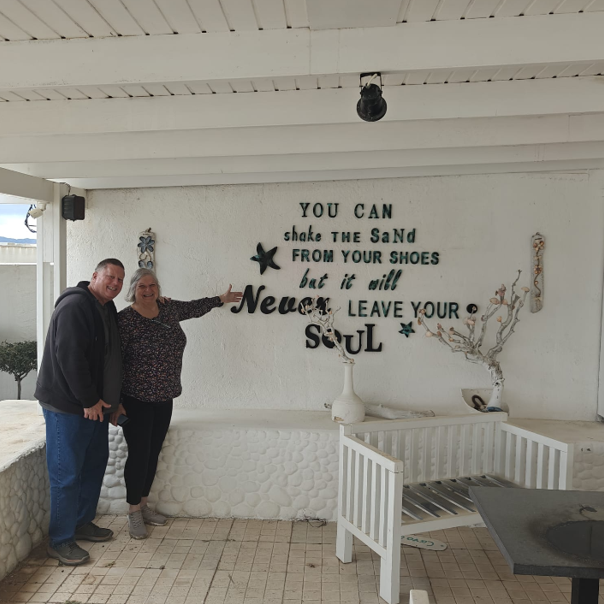
Jim and Lori on Kos Island, Greece

Last week, I shared my husband’s strange encounter with the universe. This week, it’s my turn.

Ever since I had my mtDNA test in 2010, I’ve wanted to visit Kos Island in the Aegean Sea. The results confirmed a family story my grandmother, Mary Kos Koss, told me years ago.

As a child, I had asked her where our family came from. “A village outside of Zagreb,” she said.

Something made me ask again, where had they lived before that? She paused, then told me that long ago, around the time of Christ, the family had been grape farmers on an island to the south. They left due to overpopulation and drought, moving inland.

At the time, the only “island” I knew was from Gilligan’s Island. Still, I made a quiet promise to myself: one day, I would find that place.

It took nearly sixty years.

My only regret is that my grandmother wasn’t here to hear the result.

DNA revealed that my maternal line had crossed the island of Kos. What makes that extraordinary is this: the surname had been there all along. Kos.

They had forgotten the place but carried its name for generations.

I suppose it shouldn’t surprise me that when I finally planned the trip, the universe didn’t make it easy. My husband found a great deal to travel to Greece on September 11. In hindsight, perhaps the date should have given me pause but it didn’t.

Two travel agents couldn’t figure out how to get us there, so I booked the flights myself. Then I added two extra days after the tour so I could finally visit Kos.

A week before departure, we were told the trip might be canceled. The cruise ship was stuck in the Strait of Hormuz due to the Iran conflict.

Three days later, a new plan emerged: instead of visiting Turkey, Rhodes, and Santorini, we would spend four days in Crete. Not ideal but I still had my eye on Kos.

What I didn’t realize was that this detour would make the most unexpected moment of the trip possible. On our third day in Crete, the sky changed.

It shifted from bright blue…
to white…
to pewter…
and then to red.

Breathing became difficult. My eyes burned. Some people whispered about the apocalypse.

I suspected a Sahara dust storm. We probably should have stayed at the hotel that evening. Instead, we kept our plans to meet a group of University of Crete students at a taverna. As educators, neither my husband nor I felt right canceling.

The drive there was… questionable. Imagine a bus navigating mountain roads with no guardrails, in near-whiteout conditions except the sky was red.

Still, we pressed on and we arrived safely.

At dinner, one of the students sat next to me and asked what had brought me to Greece. I told her my story. She listened carefully, then stood and said, “I’ll be back.”

A few minutes later, she returned with someone else.

My husband later said it best: “She looked like you… fifty years ago.” Her name was Argy. She was from Kos.

We spent the evening talking about her future, my upcoming visit to her homeland, and the strange coincidence that had brought us together. We laughed. We sang. We danced. At one point, we looked at each other and simply agreed, we must be related. Thirty generations back, perhaps.

Of course, with European ancestry, that’s not unusual. But the resemblance… that was something else entirely. Even her academic interests mirrored my own.

And it struck me:

If the cruise ship hadn’t been delayed…
If the itinerary hadn’t changed…
If we hadn’t gone to Crete…
If we had stayed in the hotel that night…

I would never have met her.

More than that, I likely would have missed Kos entirely.

The original itinerary would have placed us on a small island that day, one without a proper port. We would have relied on ferries to return to the ship, and due to the storm, those ferries had stopped running.

We would have been stranded. On the wrong island. Missing my connection to Athens and my flight to Kos.

Sometimes, in genealogy, we’re told to be patient. What we’re not told is why patience matters.

This is why.

And the story didn’t end there.

When we arrived on Kos, I had trouble reaching the tour company I had booked for a half-day excursion. The hotel staff tried as well, no response. It appeared I had been scammed through Travelocity.

Disappointed, not just in the lost money, but in the missed opportunity, I mentioned it to the hotel clerk. She smiled and said, “If no one shows tomorrow, I will find someone for you.”

She did.

His name was George and he was extraordinary.

George had an interest in archaeology and took us beyond the typical tourist stops, to the area where vineyards had grown two thousand years ago.

Today, it’s a Roma encampment.

I couldn’t help but laugh. My grandfather was of Roma descent. His surname? Kos, later Anglicized to Koss.

Standing there, I had to wonder: Had his line once lived here, too? I don’t have the YDNA to prove it. Two cousins could test, but neither is interested.

For now, it remains a question.

But I’ve learned this much: In genealogy, we follow the paper trail. Sometimes, if we’re lucky something else leads us the rest of the way.

Some journeys take sixty years to begin.

Others have been waiting for thousands.

Tuesday, October 6, 2026

A Special Offer for Genealogists

 After reading my recent open letter concerning NARA Notice 2026-037 and the proposed closures of the Chicago and San Bruno facilities, the folks behind AncestorOS reached out with an offer for my readers.

AncestorOS, created by Michael L. Strauss, AG, and his son, includes research logs that record not only what you find, but also partial, not found, and pending results, something particularly important when researching records that may never have been digitized. It also includes a database search log and Evidence Explained citation templates.

They are offering a 7-day free trial with no code required. Nothing is charged until day 8. After the trial, plans begin at $15 per month; the $40 Pro plan adds client and invoicing tools for professional genealogists.

AncestorOS runs in a web browser and is also available as an Android app.

Learn more or try it here:
https://ancestoros.com

I have not been paid to share this offer. I’m passing it along because the developers reached out after reading my NARA post and thought the research-tracking tools might be useful to my readers.

By the way, I was fortunate to be able to tour behind the scenes at the newly opened Indiana State Archives in Indianapolis last Friday. Here's their QR Code. Are you stumped with an Indiana brickwall? Contact them for help:

Friday, October 2, 2026

When the Universe Almost Got it Right


AI Image

It’s October, my favorite time of year for sharing the synchronicities I’ve experienced over the past year.

I think I may have finally found a clue to what triggers these odd experiences if “channeling” is even the right word. For me, it seems to be travel.

Last year, we stayed close to home due to my husband’s surgery. This year, now that he’s recovered, we’ve been on the move again and with that movement came two unusual moments. One for him, one for me.

This week, we’ll talk about his.

On my mother’s 108th birthday, I made the three-hour drive to Chicago to have the last of our dual citizenship documents apostilled.

The date wasn’t intentional. I had planned to go the week before, but I was still recovering from the Sahara dust storm I encountered in Crete. April 14th simply became the most practical option.

The drive was anything but smooth; pounding rain, a major accident, closed exits, heavy traffic, and no convenient parking. What should have taken three hours stretched to nearly four.

At the clerk’s office, things went surprisingly well.

I had expected an issue with my mother’s record. Her official “birth record” was, in fact, a no record found document something I knew might happen. Family history and church records I obtained confirmed that her birth had been registered through a Roman Catholic parish, which at the time was acceptable. Later changes in the law complicated that.

What I didn’t expect was that the county would issue an official vital record stating the absence of a record. Several colleagues have since told me that shouldn’t have happened, that it should have been a simple letter.

The apostille clerk hesitated. Paused. Looked again.

Then approved it.

Some might call that a gift from the universe. I call it something simpler: common sense.

We didn’t linger. Severe storms were forecast, and we wanted to get home.

Crossing into Indiana, as we passed through Gary, my husband suddenly said:

“I’d like to drive by my old house.”

This was… unusual.

I’m the one who detours for old homes, cemeteries, and ancestral land. He’s the one who prefers the direct route. And we had already agree, get home as quickly as possible.

I nearly made the exit but couldn’t get over in time.

I asked if he knew another way. He did.

Then he said something that stopped me: “I don’t know why I just said that. I have no idea why I want to go there.”

We had just returned from Greece, where he had patiently followed me to a remote ancestral location tied to my mtDNA from two thousand years ago. So, naturally, I was willing to return the favor. Fifteen minutes out of our way seemed more than fair.

As I moved toward the next exit, he spoke again: “I didn’t know we had to pay a toll here. Forget it. Just go home.”

I asked if he was sure. He was.

Again, he said: “I don’t even know why I wanted to go.”

We made it home just before the storms hit. As we walked in the door, his phone pinged. An email.

He opened it, paused, and said: “Oh… you won’t believe this.”

The message was from his childhood friend, Bill, who now lives in California.

Bill had traveled to northwest Indiana to visit his mother who, as it turns out, shares the same birthday as my mom's. Her 91st.

While in town, Bill decided to visit his old neighborhood. He stopped at their former elementary school now an antique mall.

And there, on the wall, were class photos. Not from every year. Not from every class. Just his class, grades 1 through 5.

At that exact moment, while we were passing through Gary on the interstate, Bill was standing there, looking at those photos, thinking about my husband.

He wrote that he wished he had thought to reach out. That they could have met.

We had been minutes away.

One exit.

One decision.

And yet we drove on.

I can’t help but think of the FAN Club in genealogy: friends, associates, and neighbors. The people who surround our ancestors and, in many ways, become extensions of family.

We trace them on paper. We follow their movements. We reconstruct their connections.

But sometimes those connections don’t stay in the past. Sometimes, the connection is still there.


We just don’t take the exit.

Hidden Way: A Genealogist's Mystery

  Last October, I wrote about an extraordinary wedding record I discovered for my maternal grandmother, Mary Koss. This year, Grandma ...