Showing posts with label Chicago. Show all posts

Friday, December 19, 2025

Part 4: Helpful Hoosiers, Elusive Records, and One Good Clerk


AI Image

This is a continuing series on my recent adventures to acquire documents for dual-citizenship. You can read earlier posts here - here - and here.

We were up bright and early on Wednesday, ready to track down a divorce record at the Porter County, Indiana courthouse before they even opened.

Here’s another tip for researchers working in Indiana: be prepared to feel like a threat. Most facilities are swarming with armed officers who clearly believe they're guarding nuclear codes rather than 19th-century paperwork. And no, you can’t bring your cell phone in. Doesn’t matter if you need it to pay. Doesn’t matter if you’re old and holding a manila folder. It’s Wild West rules. Don’t bother asking for an exception. I warned you.

As expected, they couldn’t locate the record.

I thanked them for the stack they had mailed me two years ago, minus the final dissolution of marriage I actually needed certified. Last time, it took them three months to find anything, and they charged me $50.00, a dollar per page, even though they’d made five copies of the same ten pages. No, it wasn’t a juicy divorce. Just sloppy duplication.

This time, I showed them the exact document I needed. I was told I’d hear back once they found it.

Here we go again.

One Clerk, One Win

On to the Porter County Health Department, where I entered a bit too early for some folks’ comfort. While I stood silently at the counter, I overheard one clerk complaining about “letting people in before we open.” (Hi, yes. That would be me.)

Thankfully, another clerk came to the rescue. She was efficient, kind, and within five minutes, I had the certified record I needed.

I mentioned the nightmare from the day before in Gary, and she replied with a sigh: “I couldn’t even get my own birth certificate from them. I had to go through the state.” That's two locals that had that problem!

So maybe I was lucky after all.

A Church with a Lock and a Secretary with a Key

We drove back to Lake County to revisit the church that had been closed the day before. Again, the door was locked and the secretary spoke to us through it. When I explained what I needed, she let us in and quickly found the baptism and marriage books.

She couldn’t locate the names but from across the desk, upside down, I spotted them and pointed them out. She allowed me to take a photo of the entries, but only after covering up the rest of the page. I didn’t bother mentioning that many dioceses have digitized records entirely, so full-page images are already online.

She couldn’t issue the certificates, though as there was no priest available, and wouldn’t be one “for a while.” The plan was to mail them when a priest showed up.

Which, given how things were going, might be never.

Cemetery Software and the Mystery of the Missing Priest

Next, we made a quick stop at the cemetery, where I hadn’t planned to clean any graves, but found myself wiping down markers anyway. I was there to get an updated cemetery record for the family plot. The version I had was from 2001, and a new family member had since been buried.

They had upgraded to new cemetery software. Unfortunately, no one knew how to print a basic update using it.

So one employee simply handwrote the new information and told me to submit it alongside the old printout. (Ah, technology!)

Déjà Vu with a Twist

While there, I got a call from Porter County. They told me to check my email to confirm they’d found the divorce record.

Cue near-heart attack.

I checked: no email. Nothing in spam. I called back, no voicemail. I called again. The clerk laughed and said, “Oh, I didn’t send it yet.

I told her we were already on our way.

One Archivist’s Righteous Indignation

And then the Chicago Archdiocese archivist called.

She wanted me to know firmly that my grandparents had not married at St. Salomea’s and that she would not be refunding my money.

I hadn’t asked for a refund.

She was clearly annoyed that I had requested a church record despite already having a civil marriage certificate number. I explained that the county couldn’t find the record.

Her response? “They should find it.” Right - shoulda - woulda - coulda!

As if that’s something I can make happen.

She then turned her attention to the birth/baptism record copies I had submitted for reissuance. Because mine were in English and the parish books were in Latin, she couldn’t issue a new version.

I told her Latin was fine.

Next excuse: the form she uses doesn’t include the word “birth,” and my copy did. She couldn’t reissue it for that reason, either.

I simply said, “That’s okay. I’ll explain that policies have changed over time.

She grumbled something about being unsure when she’d get around to it. I told her to mail it. We were already heading home.

Tally So Far?

Two days. Fourteen stops. Five records. Not great. 

Saturday, June 15, 2024

My Swedish Dilemma #2


Lovisa Carlsdotter Johnesson

While in Sweden I hoped to discover more about my husband’s maternal great grandmother, Lovisa Carlson. Her father was Carl Gustaf Johannesson, a widower, who emigrated with Lovisa to Chicago in 1887.

Lovisa is something of a mystery even in Sweden as several genealogists could not understand her movements in the country. She was born in Gränna, Jönköping but followed her sister to live in Ostergötland. That was according to church records in Gränna, however, she never shows up in Ostergötland church records.

Lovisa’s mom, Stina Jonsdotter, died in 1866. Lovisa’s sister returned home and Lovisa followed her in 1867. Lovisa is found living in her father’s household until they both decided to depart Sweden from Jönköping on 11 May 1887.

By this time Chicago had a very established Swedish district so it is not surprising that they relocated there. Probably they knew of others from their area who had gone before them.

The problem is where did they live and what did they do while in Chicago? I was hoping to find church records as there was only one Lovisa Carlson in city directories during this time but it wasn’t my Lovisa, the other woman was a widow.

Two years after arriving Lovisa married in Chicago widower Anders Johannesson. I have the original church marriage record with the pictures of the couples sadly removed. The problem is that she was recorded as Miss Lovisa Johannesson. All other records show her as Carlson. Also missing on the record is the name of the church. I do have the pastor so I had hoped to link him to a church and possibly discover more info. The governmental records provided no answers.

The couple then moved to Porter County, Indiana where Anders had been living with his children from his first marriage.

So many mysteries, so little time!

Friday, June 7, 2024

My Swedish Dilemma #1

Estate Near Sjohester, Sweden


When my husband and I went to Sweden in April we visited the family home and church for ancestors who were on both his maternal and paternal sides.

Kris and Mangus, of MinnesotaSwede.com, mentioned they were intrigued by how early Samuel August Samuelson and his parents had emigrated to the US and settled in Chicago – 1851! I never thought much about that date but knew from a mug book account that the family only remained in Chicago for one year and then relocated to Porter County, Indiana.

I discovered in Sweden the reason they first went to Chicago. Sam’s older half-brother, Carl Gustaf Johnson, had left Sweden for Chicago in 1849. Why? Samuel Eriksson was a tenant farmer who had married Anna Elisabet “Lisa” Torstensdotter after she had birthed Carl. The family stayed together working for an estate for years but in 1849 the estate let the family go as it appears that the property was sold and the new owners had their own tenants that they wanted to hire.

Samuel, Lisa, and their four surviving children moved to work at a smaller estate as tenant farmers. Perhaps there wasn’t room for Carl or he decided to set off on an adventure in America. According to Kris and Mangus, this wasn’t the time that most Swedes left the country. Only those who believed there was nothing left for them in Sweden took the long and dangerous route to North America. This was the era of sailing ships.

By 1850, Samuel had to move on to another tenancy. From visiting it became apparent that the family was on a downward slide. Each home was smaller, the land surrounding it was tiny, and the estate where they worked was not as prosperous as the former ones. It is no surprise that the family decided in 1851 to join Carl in Chicago.

But where in Chicago? Carl does not appear in the 1850 federal census. Samuel and family arrived after the census. I searched city directories for the time period but they are not found. I stopped at the Swedish Museum hoping their archive might hold some clues. Unfortunately the archivist was not in so I had to follow up with an email. Got a response that she was busy with setting up a new exhibit and would get back to me when she had time.

I then asked at the Chicago History Museum if they knew of Swedish churches in Chicago during that time period. There weren’t any as there were too few to form a congregation.

So, this mystery remains – where did they live and what did they do for the short window when they lived in Chicago?

What I did finally understand was why Samuel’s son, Samuel August Samuelson, volunteered as a Union Soldier and became a lifelong Republican (not to be confused with the current party’s belief systems). Samuel had experienced life as a child of a tenant farmer. He likely empathized with the enslaved which resulted in his joining the Civil War. I would never have figured this out unless I had stood in his former homes and saw for myself what the family had experienced.

Next week, I’ll write about another Swedish mystery that I’m still working on.


Sunday, June 2, 2024

Asking the Right Questions on a Cemetery Visit


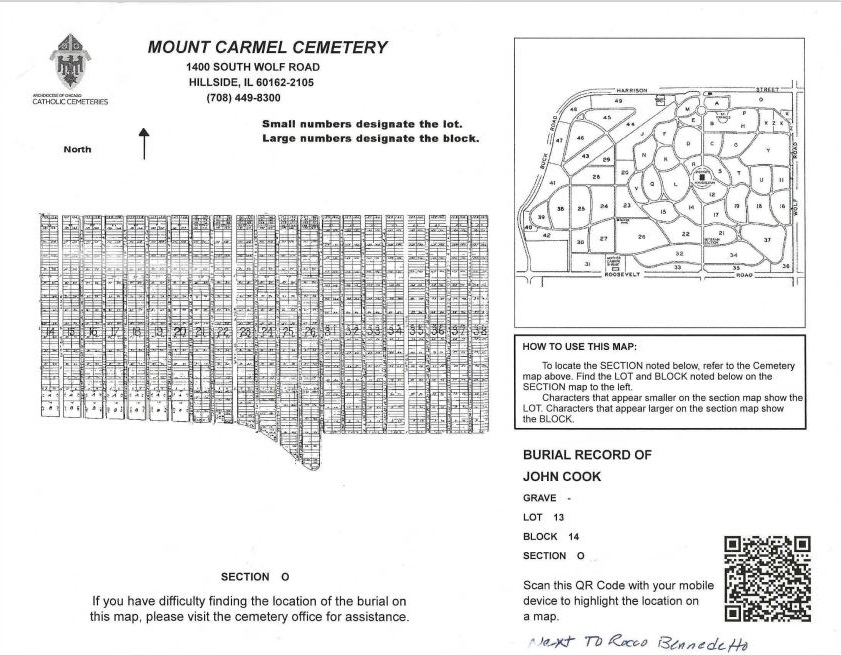
Yes, it is the time of the year to visit cemeteries. Recently while researching in the Chicago area I decided to check out Mt. Carmel Cemetery located in Hillside, Cook, Illinois. Purportedly, my husband’s second great grandparents, John and Mary “Mollie” O’Brien Cook were interred there. No one had made a Findagrave memorial for them so I stopped at the office first to ask for the location of the graves. I was the first one there when the office opened so they weren’t busy. The clerk could not readily find them. I had their birth and death info and various spellings (Cook and Cooke) but she insisted there were too many Mary’s and didn’t find John by his death date. Then it hit me! John had originally been interred in Calvary Cemetery in Evanston when he died in 1894. Some of his children had him moved to Mt. Carmel in 1918. The clerk found him with that burial date that had been entered as his death date. The clerk said she found no one on the record besides John which I found odd as I would have thought his wife, Mary, was buried by him.

I was given the printout you see above. Interesting that there was a QR Code to use to find the stone. Except, it wasn’t. The QR supposedly took you to the cemetery section. I got confused following it on my phone as it wanted to take me out of the cemetery. This turned out to be correct as the cemetery is so large that it continues across a main street. I had entered a different way and did not see that initially.

After 10 minutes and discovering that GPS wanted me to drive across grave stones, I found an alternate route and arrived at the correct section. It was a large section and I wasn’t sure of the alignment because I couldn’t be sure I was facing south. I thought I was and decided to use the compass of my car to double check.

I started at the first row and went up and down and moved on to the next, and so on until I was midway through the section. Something wasn’t right. The Cook family was Scotts Irish. John had been born Protestant in Scotland before emigrating to the US. Mary was born Roman Catholic in Ireland. They met in New York City, eloped in New Jersey and took the train west to Chicago.

My father-in-law loved to say that all of his side were raised Protestant. Except, after his death, I discovered they weren’t.

Molly, according to one of my husband’s aunts, made a deal with her husband John. All boys would be raised Protestant and the girls, Roman Catholic. What no one in the family had discovered (but me!) was that Molly had gotten the boys baptized Roman Catholic, too.

What a gal! Takes a special kind of woman to do that back in the 1850s.

Part of what I was trying to discover in Chicago was which church John belonged to. I wanted to see if they had membership records that included the boys as the family tale states. Haven’t found that yet.

I know the church where Molly had her children baptized, Old St. Mary’s. Her sole daughter, Mary Ellen, married James Hanlon at Old St. Pat’s Church on 26 May 1880. But I digress! Remember the Hanlon name because I’m going back to the cemetery story.

I quickly realized that 95% of the section I was looking at contained Italian names. This could not be right. There was no stone for the Cooks anywhere. The grass hadn’t been cut and I was getting dehydrated and exhausted from bending over flat stones trying to remove dead grass to read the names.

After an hour of this I returned to the office. Quite an interesting experience when I returned. The clerk who had helped me was waiting on someone who was screaming at her that the customer’s mother had been buried in the wrong lot. This conversation was not going well.

Meanwhile, another clerk was helping an older woman and what was likely her daughter understand the cemetery rules. I had other places to go that day so I was impatient but it was nice and cool in the office so I chose to wait.

Eventually, I was called by the second clerk. I showed the paperwork and explained I had walked the section for an hour, knew I was oriented correctly but could not find the grave stone. I explained I had left at 4:45 AM to get to this cemetery, traveling for over 4 hours and I really needed help in locating the graves. I also mentioned that the first clerk insisted that there were too many Mary Cook’s and she couldn’t find the one I needed who had died in 1901.

I’m not sure what magic the second clerk used but he readily told me that Mary was indeed buried next to John, along with several members of the Hanlon family. This explains why John’s body was moved from Calvary. Mary Ellen Cook Hanlon must have wanted her parents buried with her and her husband so John the Protestant, long dead, had no way to object to being moved to a Roman Catholic Cemetery. I’d love to know if Molly ever confessed to him that she had baptized their sons. Something I’ll likely never discover.

Anyway, it turns out the reason I could not find their tombstones is because they don’t have any. Memo to self:  Next time ASK IF THERE IS A STONE! This would also explain why the memorials were never created on Findagrave. Whoever transcribed this section of the cemetery without records would not have known they were buried there.

Speaking of records, I also mentioned to the second clerk I would like to get the records corrected since the cemetery had John’s death date wrong. He told me there was no way to correct the records. He also informed me I could not see the original burial records as that was not allowed by the Diocese. Wonderful, not! They have wrong records they won’t correct and family members aren’t allowed to see the records. What a policy of the Roman Catholic Archdiocese of Chicago.

The second clerk, however, kindly told me who the family was buried next to the Cooks. I was able to find that stone quickly and took a pic of the lot to upload to Findagrave.

Here’s reminders for the future:  Sometimes you have to ask more than one person at the site to get the full story. Always ask if there is a stone. Allow for more time as the unexpected could throw off your schedule.

I notified family that there was no stone as that was news to me. None seemed interested. If I ever win the lottery I will be spending the winnings on purchasing stones and restoring those that are there. Next week, I’ll be writing about my Swedish dilemmas.

Saturday, May 25, 2024

Verifying a Family Story in Pullman, Cook, Illinois


Family Photo Lori Samuelson

After returning from Sweden, I spent four days researching in the Chicagoland area. Both my maternal side and both of my husband’s sides lived in Chicago for a time and the Swedish trip unveiled some new mysteries that made me want to find answers there. Nothing online so boots-on-the-ground was needed. The next few weeks I’ll be writing about my discoveries and the steps I took to get the answers.

Today, I’ve shared the photo above that was taken in Chicago circa 1919. From left to right is an unnamed  neighbor of my family, Great Uncle Joseph Koss, Maternal Grandma Mary Koss, and my mother’s Godmother, known as Kuma. The little girl is my mom. The photo was undated but I know it is from the spring of 1919 for several reasons.

First, my mom is standing on her own. She was born on 14 April 1918 so she is likely about a year old. My grandmother was pregnant in the photo but barely showing; her second child was born in November 1919 in Gary, Lake, Indiana. The family moved shortly after the photo was taken. By the way they are dressed, it is spring – no heavy coats but long sleeves and my mom in a little jacket.

My grandmother had told me it was taken outside of their Pullman apartment building in Chicago. The family story was that both my great grandfather and his son-in-law, who was to become my grandfather, emigrated separately from Dubranec, Croatia with the intent of settling in Pennsylvania where they had heard there was work in the steel mills. When they arrived, however, the mills weren’t hiring so they became employed by the Pullman Company. (This is problem #1 – Pullman didn’t hire in Pennsylvania). They worked on the lines all the way to California and when the job ended, were shipped back to Chicago to work on the canal. (Problem #2-Pullman only hired for working on the cars, not on the lines). It was at that time when my great grandfather sent for his wife, Anna, and two children, Mary and Joseph, to come join him in America. The story goes on to say since he was employed by Pullman he was able to take the train to New York to meet his family and escort them back to Chicago. (Problem #3 – nothing shows that this was a perk of working for Pullman). Well, Gary, actually. He was afraid the big city would intimidate them so he moved them for six months to Glen Park, which eventually became part of Gary so that they could learn English. My grandmother finished 8th grade, the family reunited and lived in Pullman housing in Chicago until they relocated back to Gary because there was work at U.S. Steel in 1919.

I love verifying family stories and I thought this one would be a no brainer. Many of Pullman’s employment records exist at the South Suburban Genealogical and Historical Society in Hazel Crest. Newberry Library also has some ledgers and a box full. How hard could this be?

The librarians at South Suburban were absolutely wonderful! I had not completed a form for them that is required for lookups and I did not expect them to drop everything to help me out. There were several John and Joseph Koss’s but none were my relatives. One was Russian, the Austria-Hungarian became employed in 1925 long after my family had moved on, and another was Slovenian. Sigh.

I had shown the photo and that was when I learned that Pullman had once been its own town but over the years, became a part of Chicago. I also learned that Pullman did not hire laborers. Oh, dear, that was what my ancestors were considered. Another fallacy in the story is that Pullman was somehow involved with the canal building – the Illinois Michigan Canal - but that wasn’t the case.

Pullman did need working railroad tracks, however, and it was thought that perhaps my family had been hired by a company to maintain the rail lines. This makes sense as my immigrants would not likely have understood the concept of subcontractors.

These findings redirected my research question from Finding the Pullman Employment Records for Joseph and John Koss to Finding The Names of Company’s Who Maintained Railroad Tracks in the Pullman, Chicago Area between 1912-1919.

Apparently, no one has asked that question to the many archives where I looked – South Suburban, Chicago History Museum, Henry Washington Public Library, Newberry Library, and IRAD. So, this item remains on my to-do list!

I was also  interested in finding the location of the photo as my mother was said to have been born in that apartment house. My grandmother did not trust hospitals; she swore they stole babies. My cousins and I kidded her for years about that only to discover with DNA, that she had been correct. Too many babies had been switched at birth.

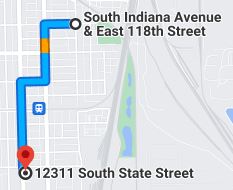
For locating the address, I turned to city directories that were not online. There is nothing like physically touching an ancient book that just might provide the answer to your burning question! Luckily, I discovered that there was a listing for Joseph Koss, laborer, who lived at 12311 South State Street in the 1917 edition. Better yet, he was the only Joseph Koss. I had been told that the whole family lived in the same apartment so by not finding John, the narrative was confirmed. In this particular city directory, only one name, typically a male, was listed per address.

Having an address was wonderful as by checking Google Maps and the Cook County Property Appraiser we quickly determined that the apartment building was still in existence and hadn’t changed much in the last 100+ years. I finally have the location of my mother’s birth! The location even ties in with the church, St. Salomea’s, where she was christened. The church wasn’t far and looking up the church history on flickr explained its need to be built in the Pullman area.

Distance from Apartment to Church, Google Earth

More work is needed to find the company that employed my ancestors. Newberry’s ledgers had Koss’ but they weren’t mine.

I have a request in with IRAD for contractors who worked in 1918-1919 on the Illinois Michigan Canal. I’d love to check out their perks, did they provide discounted train tickets? How did my great grandparent get an apartment in Pullman housing if he wasn’t employed with the company? Sometimes one find leads to more questions! Next week, I’ll tell you about what I learned at a cemetery.

1. Before You Ask AI a Question, Teach It Who You Are

      AI Image   When someone tells me they've tried artificial intelligence and "it wasn't very good," my first question ...