Saturday, June 27, 2026

A Mortgage Carved in Stone: What Ancient Greece Reveals About Our Financial Lives

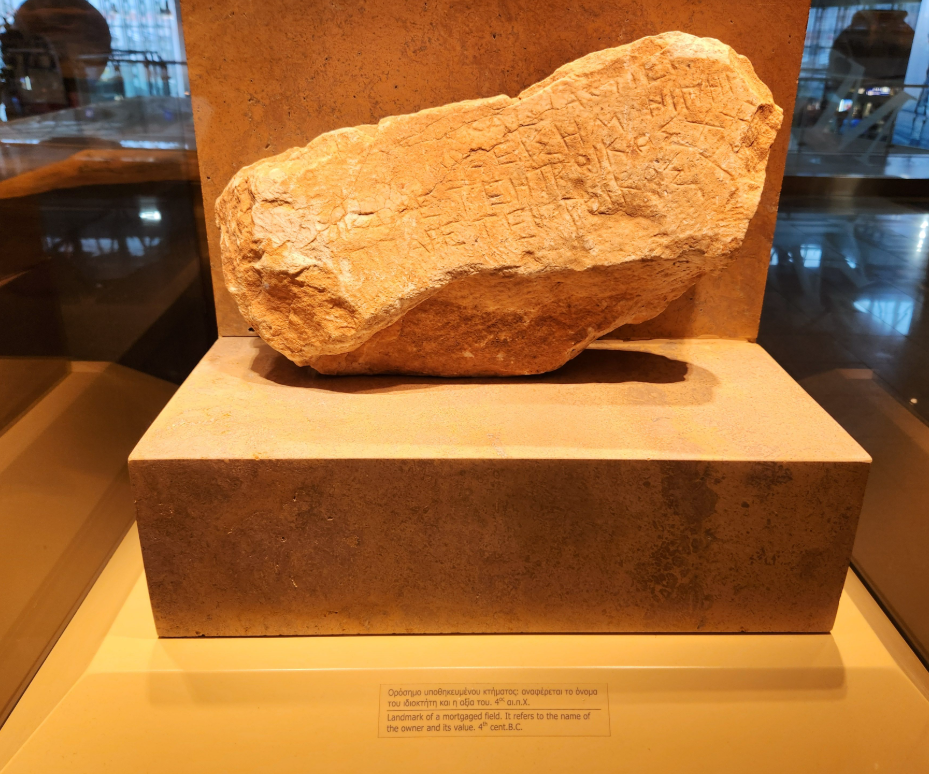
Landmark of a mortgaged field, c. 4th century BCE, Athens, Greece Airport Museum, photo by Lori Samuelson 3 April 2026.

I didn’t expect to find a mortgage record at the Athens, Greece Airport Museum.

But there it was, carved in stone.

Not a scroll. Not a document tucked into an archive. Not something filed away in a courthouse.

A rock. Sitting out in the open for the world to see.

The ancient Greeks called these markers horoi, boundary stones that recorded debt. They were placed directly on the land itself, announcing that the property had been pledged as collateral. The inscription would typically include the name of the owner and the value of the obligation.

In other words, this wasn’t just a marker. It was a public declaration: “This land is mortgaged.”

Now imagine that for a moment.

Imagine your mortgage, not buried in paperwork or hidden behind passwords but carved into a stone and planted in your front yard.

No privacy.
No discretion.
No quiet understanding between borrower and lender.

Everyone who passed by would know. Your neighbors. Strangers. Anyone walking down the road. Your financial situation on display. And we so get up tight about privacy today!

As a genealogist, I didn’t just see a stone. I saw a record. A remarkably rich one.

Here, in a single object, was evidence of:

  • Property ownership
  • Economic status
  • A named individual tied to a specific place
  • Participation in a financial system that feels surprisingly familiar

This was, quite literally, a land record and a lien combined, preserved not in ink, but in stone.

And then, of course, my mind went where it always goes. I found myself wondering…

Could one of these have held my family’s name?

It’s a long stretch, I know. My own lines don’t trace back to ancient Greece through paperwork but through maternal DNA. But that thought, that somewhere, someone’s ancestor is named on one of these stones, stopped me.

Because for that family, this isn’t just an artifact. It’s a record.

A tangible, physical link to a moment in time when land was pledged, risk was taken, and a name was important enough to be carved for all to see.

We often think of the past as distant, disconnected from our modern lives. But standing there, looking at that stone, I realized just how familiar it all felt.

People borrowed money.
They leveraged what they owned.
They took risks.
They worried about outcomes.

The tools have changed.

The systems have evolved.

But the human story?

Not so much.

Today, our mortgages live in digital files and legal documents. They’re processed quietly, stored securely, and largely invisible to the outside world.

In ancient Greece, they were anything but invisible. They were meant to be seen. There’s something striking about that difference.

Not just the lack of privacy but the permanence. Paper can be lost. Files can be deleted. Systems can change.

But stone? Stone remains.

As someone who spends her time digging through land records and probate files, I never expected to encounter a mortgage like this, one that didn’t require deciphering handwriting or chasing down courthouse copies.

It was simply there to be translated. Clear. Direct. Enduring.

Long before courthouses and filing cabinets, before clerks and digital databases, people marked their obligations in the most permanent way they knew how. They carved them into stone.

And standing there, I realized the past isn’t as distant as we think.

It’s just written differently.

Friday, June 19, 2026

5 Practical Lessons from an Ancient DNA Study

AI Image

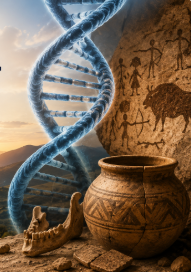
For years, genealogy has been dismissed by some as storytelling. Another study I blogged about last week says otherwise. (Genetic genealogy of the Piast dynasty and related European royal families) Done correctly, genealogy is history, biology, and evidence all working together. The study teaches us the following lessons we must adhere to:

1. One record is never enough
Even kings couldn’t be identified from a single source. It took DNA, archaeology, and documentation working together. If you’re relying on one census or one tree, you’re not done. (GPS 1 – Conduct reasonably exhaustive research)

2. Biology and paperwork are not always aligned
Non-paternity events didn’t start in modern times. They’ve always been part of family history. The difference now? We can detect them. (GPS 3 – Analyze and correlate evidence)

3. Geography can mislead you
The Piasts ruled Poland but their origins likely trace to Western Europe. Don’t assume origin based on where someone lived or held power. (GPS 3 – Analyze and correlate evidence)

4. Build your work to withstand revision
This study didn’t “destroy” history it refined it. Good genealogy should do the same. Leave room for new evidence without collapsing your conclusions. (GPS 4 – Resolve conflicting evidence & GPS 5 – create a well-reasoned, written argument that explains how the evidence supports the conclusion)

5. Genealogy is moving toward synthesis, not silos
The future isn’t records or DNA it’s both, plus context. The genealogists who thrive will be the ones who can integrate all three. (and make sure to GPS 2 – Maintain complete and accurate source citations)

Sunday, June 14, 2026

DNA Doesn’t Care About Pedigrees: What a Royal Study Just Proved About Genealogy


AI Image

I just read one of the most important articles I’ve seen in years and if you care about genealogy, you should too. (Genetic genealogy of the Piast dynasty and related European royal families)

The study confirms something many of us already suspected: The paper trail isn’t the final word.

A recent scientific study analyzed the DNA of the medieval Piast dynasty, the ruling family that built early Poland.

Not one king.
Not one tomb.

An entire dynasty.

Researchers examined skeletal remains from multiple burial sites, applied DNA analysis, and combined it with historical and genealogical data.

And what they did should make every genealogist pause:

  • They identified specific historical individuals using DNA
  • They reconstructed relationships across generations
  • They confirmed some lineages and quietly broke others

This wasn’t theory.

This was proof.

For decades, historians debated where the Piasts came from.

Local Slavic rulers?
Foreign elites?
Legendary founders?

DNA answered the question. They were not local.

Their Y-DNA traces back to a lineage far more common in Western Europe, places like England, France, and the Netherlands.

In other words, One of Europe’s foundational royal families likely came from somewhere else entirely. And then it gets even more interesting. The researchers didn’t stop at origin. They reconstructed family relationships and found something genealogists know all too well: Not every father in the records was the biological father.

At least one individual inherited royal DNA through the maternal line (mtDNA) instead of the documented paternal line (YDNA).

No scandal headline.
No dramatic accusation.

Just quiet scientific correction.

Let’s say that again: A medieval royal pedigree…Was wrong.

Now here’s where this connects directly to my work and to yours.

Because this study didn’t succeed with DNA alone.

It required:

  • Historical records
  • Burial context
  • Chronology
  • Genealogical reconstruction

Sound familiar? It should. Because this is exactly what serious genealogists do.

When I began building my books, Echoes of Britannia, my goal wasn’t just to collect names.

It was to create something durable. Something that could stand even when new evidence emerges. This study confirms that approach.

Because what they built scientifically is what we aim to build genealogically, a structure where evidence supports identity across generations.

Not just “Here’s who someone might be,” but “Here’s who they were and why we know it.”

European royal families were never isolated, pure, or static.

They were:

  • interconnected
  • mobile
  • politically strategic
  • and sometimes… biologically inconsistent

DNA is now proving what the records only hinted at and that’s powerful.

Saturday, June 6, 2026

The Scenic Route to Citizenship

If genealogy is a study in patience, dual citizenship is a graduate-level course in patience, frustration, and occasional disbelief.

Back in April, I reached out to a court-approved translator recommended by the consulate to translate and certify the records I had painstakingly collected. I waited. Nothing. I wrote again. Still nothing. Hoping for another recommendation, I contacted the consulate only to learn they no longer provide them.

Well then.

Fortunately, a former client came to the rescue and recommended a translator named Paula. We connected quickly, and I emailed the documents needing translation and certification. Somehow, and I checked twice, my own birth record performed a disappearing act and failed to attach.

Of course it did.

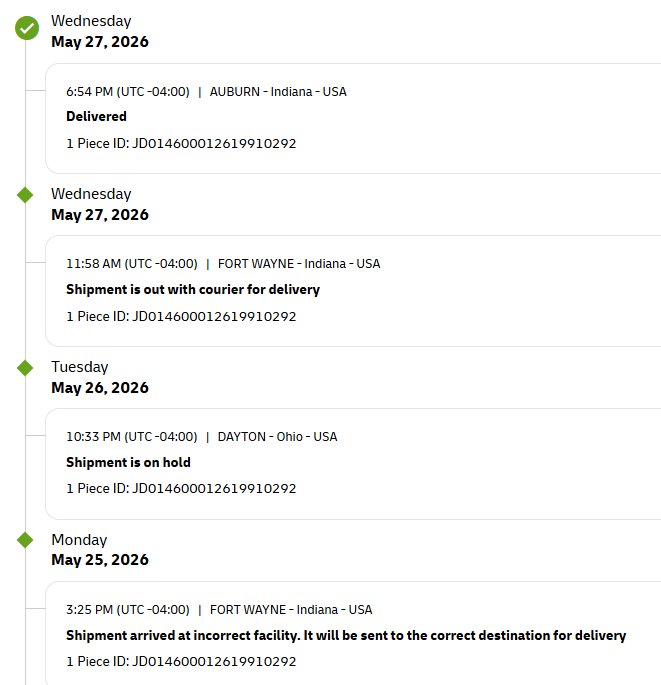
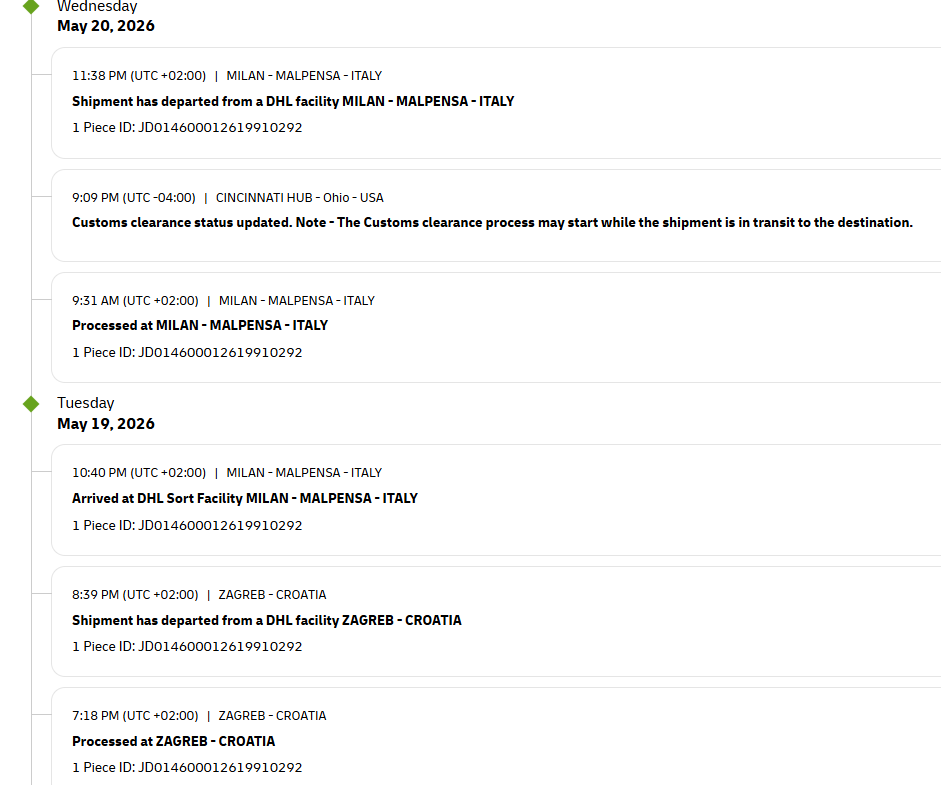
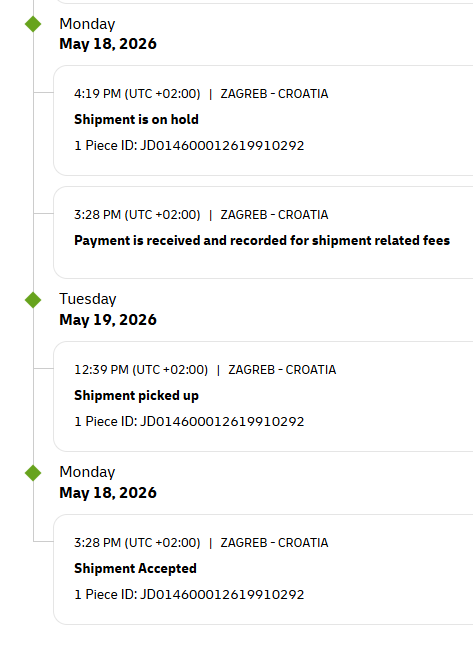
Paula mailed the completed records via DHL on 18 May, with an anticipated arrival date of 21 May. Someday, likely in October, I will share the strange saga involving an email with the wrong address and entirely wrong city. Suffice it to say, the moment I spotted the problem, I contacted both Paula and DHL. The error was not on Paula’s end.

My adventure with DHL, however, was just beginning.

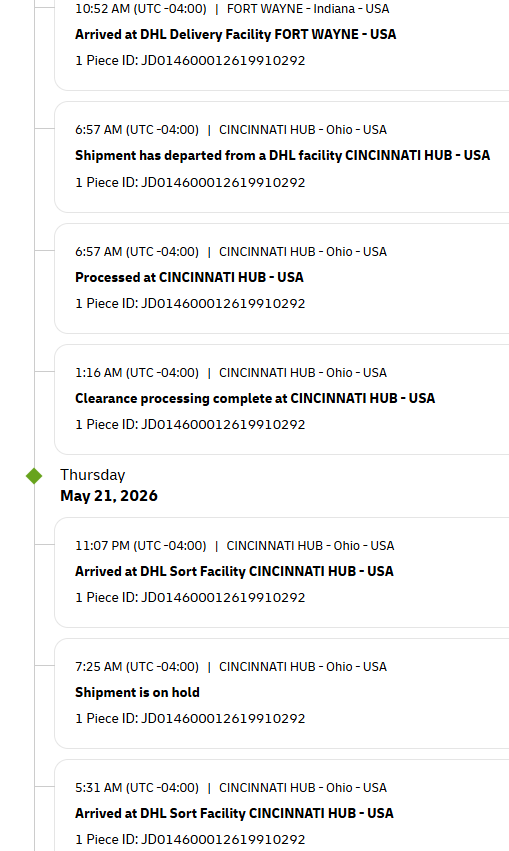
When Thursday came and went with no delivery, I remained optimistic. The package had reached Cincinnati. Surely it would arrive Friday. How long could it take to travel from Cincinnati to northern Indiana?

As it turns out: considerably longer than one might expect.

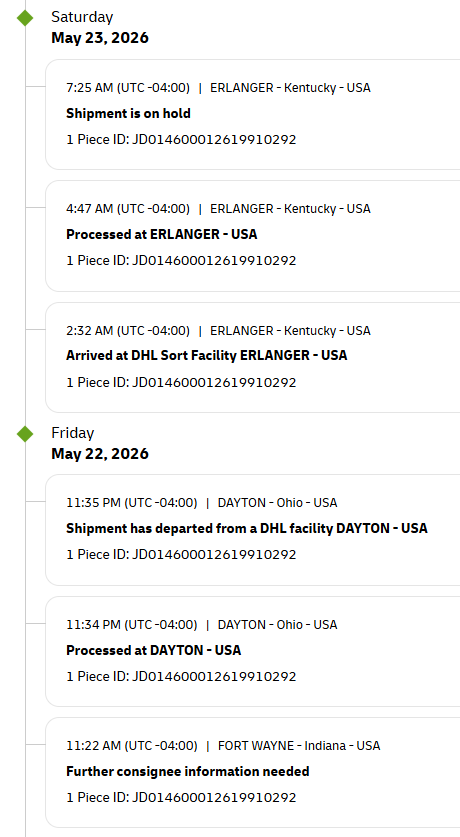
The package cleared Cincinnati at 6:57 AM Friday and headed to Fort Wayne, a short distance from my home and, in my increasingly hopeful imagination, the final stop. Instead of delivering it, DHL sent it to Dayton.

Dayton politely emailed me requesting that I verify my address again. I complied and selected Tuesday as my delivery date because, apparently, choice is an illusion and Tuesday was the only option available.

Then things became truly creative.

On Saturday, Dayton sent the package to Erlanger, Kentucky.

Why?

An excellent question. Customer Service did not know either.

Erlanger held the package hostage for two days before returning it to Fort Wayne on Monday, now a full week after it had left Croatia.

Fort Wayne then declared it had arrived at the wrong destination.

No, Fort Wayne. I live near you. We were so close to success. Had someone simply called me, I would have cheerfully driven over and rescued the wandering documents myself.

Instead, Fort Wayne sent the package back to Dayton.

Dayton placed it on hold Tuesday.

By Wednesday it had returned to Fort Wayne, which once again announced it would be delivered.

Hope springs eternal.

Unfortunately, experience had by then replaced hope with strategy. Before Fort Wayne could develop another urge to send the package sightseeing, I called Customer Service.

The shipment was finally received Wednesday at 6:54 PM.

Customer Service had promised delivery by 7:00 PM, and to their credit, they met that deadline by a remarkable six minutes, albeit nearly seven days late.

As genealogists, we love timelines. Postal timelines? Not so much.

At this point, I am fairly certain the Pony Express could have delivered the records faster and with fewer state lines involved.

The package was torn open but thankfully, the documents were intact.

And now for the painful epilogue.

This postal adventure cost over 150 euros for the original shipment. Thanks to my own missing attachment mishap, I must now spend another 150 euros to have the overlooked birth record translated and shipped.

Which means I will soon be playing the DHL Waiting Game once again.

Stay tuned.

Acadian Genealogical Research by Judy Nimer Muhn - A Review

  Every genealogist has encountered it, that moment when you're handed a family line from a place you know little about and wonder,...