Showing posts with label Greece. Show all posts

Friday, October 9, 2026

When the Past Finds You


Jim and Lori on Kos Island, Greece

Last week, I shared my husband’s strange encounter with the universe. This week, it’s my turn.

Ever since I had my mtDNA test in 2010, I’ve wanted to visit Kos Island in the Aegean Sea. The results confirmed a family story my grandmother, Mary Kos Koss, told me years ago.

As a child, I had asked her where our family came from. “A village outside of Zagreb,” she said.

Something made me ask again, where had they lived before that? She paused, then told me that long ago, around the time of Christ, the family had been grape farmers on an island to the south. They left due to overpopulation and drought, moving inland.

At the time, the only “island” I knew was from Gilligan’s Island. Still, I made a quiet promise to myself: one day, I would find that place.

It took nearly sixty years.

My only regret is that my grandmother wasn’t here to hear the result.

DNA revealed that my maternal line had crossed the island of Kos. What makes that extraordinary is this: the surname had been there all along. Kos.

They had forgotten the place but carried its name for generations.

I suppose it shouldn’t surprise me that when I finally planned the trip, the universe didn’t make it easy. My husband found a great deal to travel to Greece on September 11. In hindsight, perhaps the date should have given me pause but it didn’t.

Two travel agents couldn’t figure out how to get us there, so I booked the flights myself. Then I added two extra days after the tour so I could finally visit Kos.

A week before departure, we were told the trip might be canceled. The cruise ship was stuck in the Strait of Hormuz due to the Iran conflict.

Three days later, a new plan emerged: instead of visiting Turkey, Rhodes, and Santorini, we would spend four days in Crete. Not ideal but I still had my eye on Kos.

What I didn’t realize was that this detour would make the most unexpected moment of the trip possible. On our third day in Crete, the sky changed.

It shifted from bright blue…
to white…
to pewter…
and then to red.

Breathing became difficult. My eyes burned. Some people whispered about the apocalypse.

I suspected a Sahara dust storm. We probably should have stayed at the hotel that evening. Instead, we kept our plans to meet a group of University of Crete students at a taverna. As educators, neither my husband nor I felt right canceling.

The drive there was… questionable. Imagine a bus navigating mountain roads with no guardrails, in near-whiteout conditions except the sky was red.

Still, we pressed on and we arrived safely.

At dinner, one of the students sat next to me and asked what had brought me to Greece. I told her my story. She listened carefully, then stood and said, “I’ll be back.”

A few minutes later, she returned with someone else.

My husband later said it best: “She looked like you… fifty years ago.” Her name was Argy. She was from Kos.

We spent the evening talking about her future, my upcoming visit to her homeland, and the strange coincidence that had brought us together. We laughed. We sang. We danced. At one point, we looked at each other and simply agreed, we must be related. Thirty generations back, perhaps.

Of course, with European ancestry, that’s not unusual. But the resemblance… that was something else entirely. Even her academic interests mirrored my own.

And it struck me:

If the cruise ship hadn’t been delayed…
If the itinerary hadn’t changed…
If we hadn’t gone to Crete…
If we had stayed in the hotel that night…

I would never have met her.

More than that, I likely would have missed Kos entirely.

The original itinerary would have placed us on a small island that day, one without a proper port. We would have relied on ferries to return to the ship, and due to the storm, those ferries had stopped running.

We would have been stranded. On the wrong island. Missing my connection to Athens and my flight to Kos.

Sometimes, in genealogy, we’re told to be patient. What we’re not told is why patience matters.

This is why.

And the story didn’t end there.

When we arrived on Kos, I had trouble reaching the tour company I had booked for a half-day excursion. The hotel staff tried as well, no response. It appeared I had been scammed through Travelocity.

Disappointed, not just in the lost money, but in the missed opportunity, I mentioned it to the hotel clerk. She smiled and said, “If no one shows tomorrow, I will find someone for you.”

She did.

His name was George and he was extraordinary.

George had an interest in archaeology and took us beyond the typical tourist stops, to the area where vineyards had grown two thousand years ago.

Today, it’s a Roma encampment.

I couldn’t help but laugh. My grandfather was of Roma descent. His surname? Kos, later Anglicized to Koss.

Standing there, I had to wonder: Had his line once lived here, too? I don’t have the YDNA to prove it. Two cousins could test, but neither is interested.

For now, it remains a question.

But I’ve learned this much: In genealogy, we follow the paper trail. Sometimes, if we’re lucky something else leads us the rest of the way.

Some journeys take sixty years to begin.

Others have been waiting for thousands.

Saturday, June 27, 2026

A Mortgage Carved in Stone: What Ancient Greece Reveals About Our Financial Lives

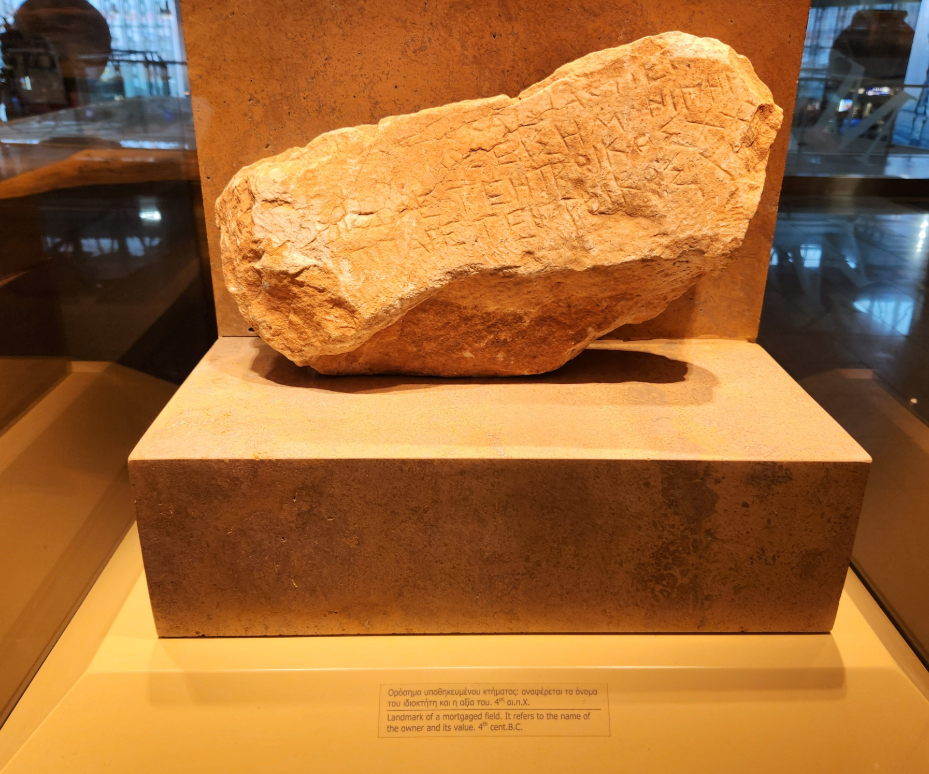
Landmark of a mortgaged field, c. 4th century BCE, Athens, Greece Airport Museum, photo by Lori Samuelson 3 April 2026.

I didn’t expect to find a mortgage record at the Athens, Greece Airport Museum.

But there it was, carved in stone.

Not a scroll. Not a document tucked into an archive. Not something filed away in a courthouse.

A rock. Sitting out in the open for the world to see.

The ancient Greeks called these markers horoi, boundary stones that recorded debt. They were placed directly on the land itself, announcing that the property had been pledged as collateral. The inscription would typically include the name of the owner and the value of the obligation.

In other words, this wasn’t just a marker. It was a public declaration: “This land is mortgaged.”

Now imagine that for a moment.

Imagine your mortgage, not buried in paperwork or hidden behind passwords but carved into a stone and planted in your front yard.

No privacy.
No discretion.
No quiet understanding between borrower and lender.

Everyone who passed by would know. Your neighbors. Strangers. Anyone walking down the road. Your financial situation on display. And we so get up tight about privacy today!

As a genealogist, I didn’t just see a stone. I saw a record. A remarkably rich one.

Here, in a single object, was evidence of:

  • Property ownership
  • Economic status
  • A named individual tied to a specific place
  • Participation in a financial system that feels surprisingly familiar

This was, quite literally, a land record and a lien combined, preserved not in ink, but in stone.

And then, of course, my mind went where it always goes. I found myself wondering…

Could one of these have held my family’s name?

It’s a long stretch, I know. My own lines don’t trace back to ancient Greece through paperwork but through maternal DNA. But that thought, that somewhere, someone’s ancestor is named on one of these stones, stopped me.

Because for that family, this isn’t just an artifact. It’s a record.

A tangible, physical link to a moment in time when land was pledged, risk was taken, and a name was important enough to be carved for all to see.

We often think of the past as distant, disconnected from our modern lives. But standing there, looking at that stone, I realized just how familiar it all felt.

People borrowed money.
They leveraged what they owned.
They took risks.
They worried about outcomes.

The tools have changed.

The systems have evolved.

But the human story?

Not so much.

Today, our mortgages live in digital files and legal documents. They’re processed quietly, stored securely, and largely invisible to the outside world.

In ancient Greece, they were anything but invisible. They were meant to be seen. There’s something striking about that difference.

Not just the lack of privacy but the permanence. Paper can be lost. Files can be deleted. Systems can change.

But stone? Stone remains.

As someone who spends her time digging through land records and probate files, I never expected to encounter a mortgage like this, one that didn’t require deciphering handwriting or chasing down courthouse copies.

It was simply there to be translated. Clear. Direct. Enduring.

Long before courthouses and filing cabinets, before clerks and digital databases, people marked their obligations in the most permanent way they knew how. They carved them into stone.

And standing there, I realized the past isn’t as distant as we think.

It’s just written differently.

Saturday, April 18, 2026

Greece: Tourist and Genealogywise


A sculptural gathering of the twelve Olympian gods, seated and standing in hierarchical order, evokes the structure of divine authority on Mount Olympus. At the center sits Zeus, surrounded by the major deities who governed every aspect of ancient Greek life—from war and wisdom to love, the sea, and the harvest. Unlike mythological battle scenes, this composition presents the gods as a unified, if complex, family—ordered, powerful, and ever-present in the Greek world. Photo by Lori Samuelson 25 Mar 2026, Acropolis Museum, Athens, Greece.

I’ve been getting quite a few messages asking about our recent trip to Greece, so I decided to put together a two-part blog with some background this week, and next week I’ll share recommendations if you’re planning your own adventure.

A week before our March departure, we received an email from our travel agent, Gate 1 Travel, telling us our cruise ship was stuck in the Strait of Hormuz. Translation: your trip might not happen.

Three days later, they gave us two options: cancel and get a full refund, or accept a revised itinerary: four days in Crete.

We went.

I refuse to let bullying politicians dictate whether I get to walk in the footsteps of my ancestors.

The trip itself? Smooth, except for the weather, which seemed determined to test our resolve. Intermittent downpours followed us as we climbed mountains in the cold. Where was Zeus when we needed him?

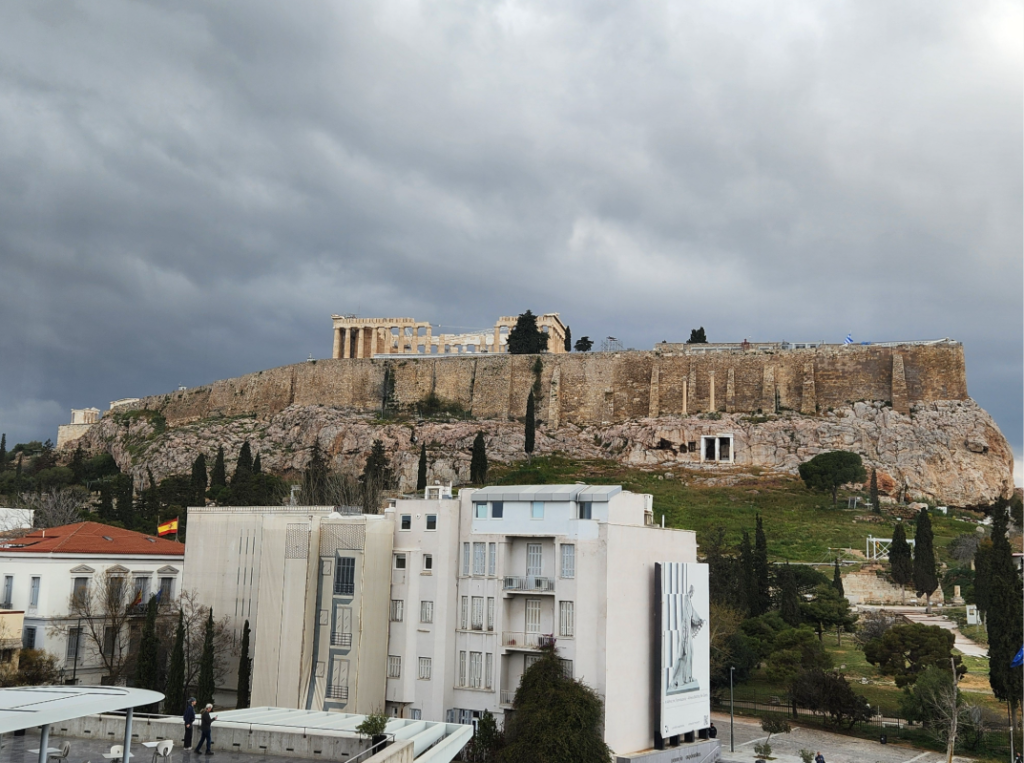
Storm clouds over the Parthenon, 25 March 2026, Photo by Lori Samuelson.

We made our way through Athens, climbed the Parthenon, continued on to Olympia, then Delphi where I picked up a cough that I chose to ignore, and on to Meteora. From there, back to Athens and a short flight to Crete.

And that’s where things got… strange.

I swear our hotel room in Crete was haunted. The first night, I had vivid, unsettling dreams. When I woke, my side of the mattress was halfway off the bed. I had to wake my husband to help fix it.

The next night? His turn. Same thing, odd dreams, followed by a thud as he hit the floor. His mattress was halfway off as well.

We’ve been married over fifty years. This has never happened. Not once.

Sahara Dust Storm before it got worse - seriously! Photo by Lori Samuelson, Crete, 1 April 2026.

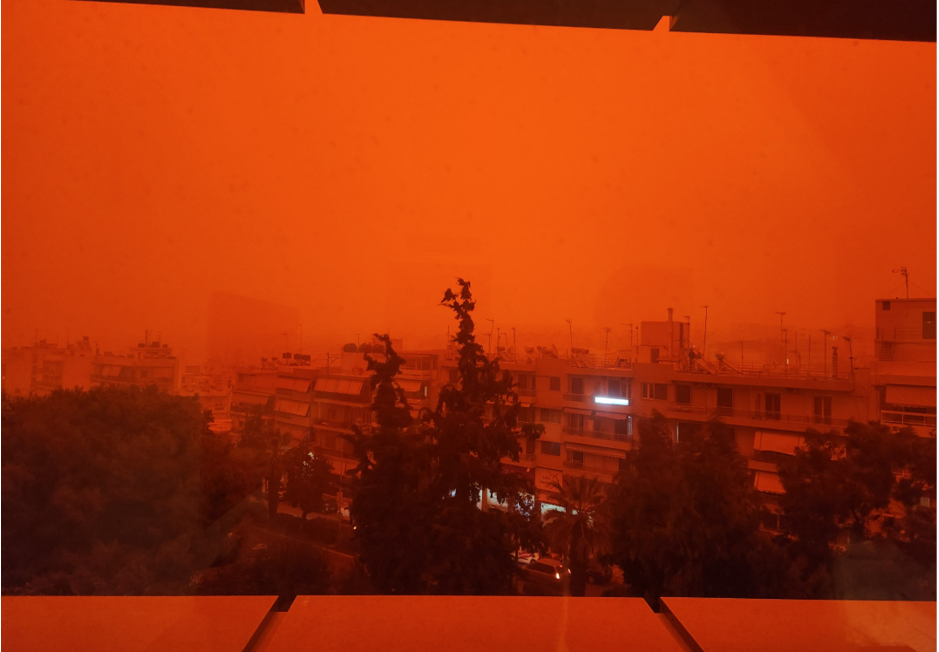
Then came day three: a Sahara dust storm. Apparently they happen about three times a year, but this one, on April 1st, of all days, was next level. Nature’s idea of an April Fools joke.

Housekeeping had left our balcony door open.

We came back to a room coated in fine orange dust. My cough worsened, my eyes started itching and watering, and breathing became… challenging. My husband? Completely fine.

So now we know; I’m apparently allergic to the Sahara. Who knew?

Sahara Dust Storm when it went to white out? (red out?) conditions, Photo by Jim Samuelson, Crete, 1 Apr 2026.

Here’s the part that still gives me pause. Had we stayed on the cruise, we were scheduled to be in Santorini that same day. Cruise ships can’t dock there, so passengers rely on ferries and with that weather, those ferries wouldn’t have run.

We would have been stranded. No hotel. No luggage. No backup plan.

So… should I thank those bullying politicians?

Nope. Still not doing it.

One of the highlights of the trip was meeting a probable cousin at a small taverna in Crete. She’s a student at the University of Crete, originally from Kos and she looked exactly like me fifty years ago. Same dark hair, same eyes, same build. It startled my husband more than a little. She is even majoring in an area I did.

Maternal genetics don’t mess around even though I'm unable to prove we're cousins.

The next day we flew to Kos Island, where I had booked a half-day tour through Travelocity. The company happily charged my credit card back in December and then never showed up.

Fortunately, the staff at the Kos Aktis Art Hotel stepped in and found a replacement: a wonderful guide from UniKos Tours.

He took me to what had once been vineyards, very likely the same land my family worked generations ago. Today, it’s a gypsy camp. The residents didn’t mind me taking photos, which felt like a small but meaningful connection to the past.

From there, we visited the Asklepieion of Kos, walked the mountainside associated with Hippocrates, stood beneath the tree where he is said to have taught, explored two medieval castles, stopped at Aphrodite’s temple where the sky promptly opened up and drenched us and found a perfect place to watch the sunset from a mountaintop.

It was, in a word, extraordinary.

Our return home, however, was anything but.

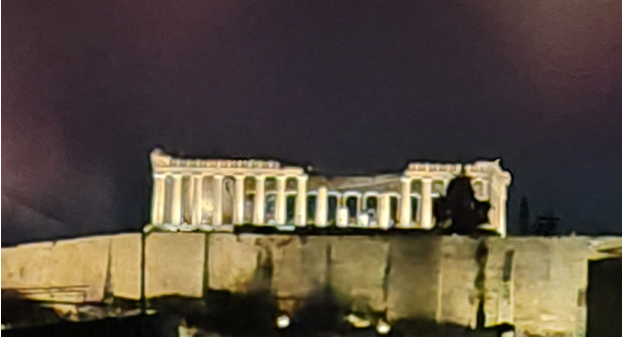
Parthenon at Night. Photo by Lori Samuelson 25 March 2026.

By then, my cough had worsened and my eyes were constantly watering. We spent a sleepless night in the Athens airport before flying to Munich (2.5 hours), waiting two more hours, then enduring a 9.5-hour flight to Chicago. After that? Two hours navigating customs and security, then sprinting to catch our final 30-minute flight to Fort Wayne. We made it with 23 minutes to spare.

Then came the 40-minute drive home.

Happy Easter.

Easter Monday was spent going from doctor to doctor in Auburn. No one had seen a “Sahara dust storm victim” before, which didn’t inspire confidence. My physician child kept telling me to just ask for allergy meds, but no one would listen. I kept getting sent somewhere else.

I finally landed in an eye doctor’s office, someone who actually knew what they were looking at, and I’m now on the mend.

Several locals have told me they’d never travel the way I do, for fear of getting sick.

I’d do it again tomorrow.

Life is what you make of it. Fear doesn’t take you anywhere worth going.

Next week, I’ll answer some of the questions I’ve been getting about traveling to places a little off the grid.

Wednesday, April 8, 2026

An Island Without a Name

Photo by Lori Samuelson 4 April 2026

Did you guess where I traveled? It was Kos Island, Greece.

I’ve gone back in time, way back, to a place where my ancestors lived nearly 2,000 years ago. This journey didn’t begin with a record set or an archive, but with a story passed down by my grandmother. She said our family once left an island to the south, around the time of Christ. They were vintners. There were too many people. The land was dry. They left because they had to. She didn’t know the name of the island, only the reason they went.

For years, that story lingered as just that: a story. But when mitochondrial DNA entered the picture, something remarkable happened. My mtDNA traces directly across Kos Island, an island whose name my family has carried, in one form or another, since at least the 1200s, when I first find them documented in their later home in Croatia. Even more compelling, historical research confirms that Kos was overpopulated and experienced periods of drought roughly 2,000 years ago. The pieces fit, not perfectly, but persuasively.

What fascinates me most is not that the story was complete, but that it was true enough. Family stories rarely preserve dates, place names, or precise routes. What they do preserve are motives: hunger, pressure, hope, survival. In this case, the story of farmers leaving an unnamed island aligns with both genetic evidence and environmental history. That’s not coincidence, that’s migration memory.

This is why I never dismiss family stories outright. Even when details are missing or blurred, they often contain a core truth waiting to be tested. With the right tools, DNA, geography, climate history, and records, we can sometimes confirm far more than we expect. Migration leaves footprints not just in documents, but in names, occupations, and the quiet persistence of who we are.

From Indentured Servant to Research Assistant: My Journey with AI

  AI Image When people ask how I use AI in genealogy, they often assume I simply type a question and accept whatever answer appears on ...