Showing posts with label Education. Show all posts

Wednesday, July 29, 2026

Book Review: Three New Scottish Reference Works from David Dobson

Available at Genealogical.com

David Dobson has built a well-earned reputation over many years for locating and compiling records relating to Scottish families, migration, military service, and settlement throughout the Atlantic world. Three of his latest publications continue that tradition, each serving as a specialized reference tool for genealogists researching Scottish ancestors.

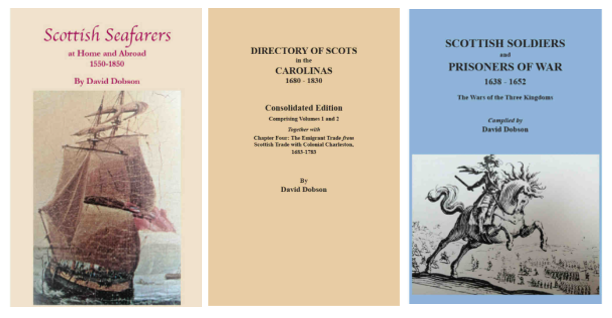
The first volume, Scottish Seafarers at Home and Abroad, 1550–1850, is exactly what its title suggests. Rather than a narrative history, it is an alphabetical compilation of individuals connected with Scotland's maritime community over a three-century period. Entries are intentionally brief, typically providing a name, occupation or relationship to a vessel, a date, and a citation directing researchers to the original source. A concise introduction explains the scope of the work, while a bibliography and key to the source abbreviations assist the researcher in locating the original material.

Scottish Soldiers and Prisoners of War, 1638–1652 follows the same format. Researchers interested in Scotland during the turbulent years of the Wars of the Three Kingdoms will find an alphabetically arranged listing of individuals identified in military and related records. As with the seafarers volume, the real strength of the book lies in bringing together names from numerous historical sources into a single, easy-to-use reference.

The largest of the three books is Directory of Scots in the Carolinas, 1670–1830. Spanning over 600 pages, this volume consolidates material from several of Dobson's earlier publications into one comprehensive reference. In addition to combining previously published directories, it incorporates material from his work on Scottish trade with colonial South Carolina, making this an especially convenient resource for anyone researching Scottish migration and settlement in the Carolinas.

These are not books intended to be read from cover to cover. Instead, they function as finding aids, reference works designed to help researchers quickly determine whether an individual appears in a particular historical record before consulting the original source. For genealogists with Scottish ancestry, that can translate into a considerable savings of research time.

I particularly appreciate having specialized reference works such as these gathered in one place. Many of the original records cited are scattered among numerous repositories and publications in the U.S. and abroad. By compiling them into searchable surname directories, Dobson has made it much easier for researchers to identify promising leads that might otherwise remain undiscovered.

If your Scottish research involves maritime occupations, seventeenth-century military service, or early settlement in the Carolinas, these volumes deserve consideration. While experienced genealogists will still want to examine the original records cited for complete context and analysis, these compilations provide an excellent starting point for identifying those records.

As always, no single reference work contains every answer. However, resources like these can often provide the clue that points us toward the next record and in genealogy, that next record is often where the real story begins.

Books are available from Genealogical.com:

Scottish Seafarers at Home and Abroad, 1550–1850

Scottish Soldiers and Prisoners of War, 1638–1652

Directory of Scots in the Carolinas, 1670–1830

Friday, January 23, 2026

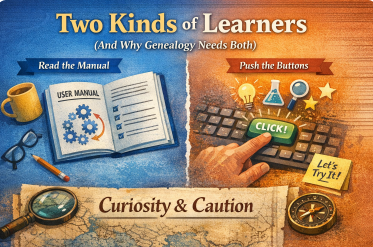
Two Kinds of Learners (and Why Genealogy Needs Both)


AI Generated

Someone recently observed that there are two kinds of people in the world:

Those who learn by reading the manual.
And those who learn by pushing buttons.

My husband calls me “click-happy.” He means it affectionately and accurately. When I’m faced with new technology, my instinct is to explore. To try things. To see what happens. That’s how I learn.

Some people learn top-down. They want the framework first. The theory. The rules. They read, then they act.

Others learn bottom-up. They learn by doing. By experimenting. By poking at the edges and seeing what’s possible, then building understanding from experience.

And over the years, I’ve realized something important: neither of these approaches is wrong.

Most of us are actually a mix of both, depending on the tool and the stakes.

But in genealogy? Let’s be honest. Very few of us learned Ancestry, FamilySearch, DNA tools, or mapping tools by sitting down with a 300-page manual first. We learned by searching. Clicking. Trying. Backing up. Trying again.

And when I look back at some of the most important breakthroughs in my own research: Croatia, the Palatine migrations, strange boundary changes, unexpected court records, whole clusters of “this can’t be right… oh wait, it is” moments, not a single one of them began with a manual.

They began with curiosity.

With clicking.

With trying something that wasn’t in the plan.

The manual tells you how a tool is supposed to work. Exploration shows you what it’s actually good for.

Here’s the part that really matters, though: the real risk in genealogy (and in tech generally) isn’t clicking. It’s not having good habits.

What actually protects your work is not fear. It’s practice:

  • Working on copies, not originals
  • Having backups (and backups of backups)
  • Using version history and undo (Ctrl+Z) after analyzing and discovering your first find wasn't accurate
  • Not trusting any single tool, human or machine, blindly

Fear doesn’t protect data. Habits do.

We already live in a world where far more damage is done by accidental deletes, bad syncing, overwritten files, and simple human error than by any new tool. AI doesn’t change that reality, it just joins the long list of tools we learn to use wisely.

And in a field like genealogy, which is built on exploration, pattern-spotting, and following trails that might go nowhere, curiosity isn’t a flaw. It’s a requirement.

Archives don’t come with manuals.
Families don’t come with instructions.
Records don’t announce what they’re going to reveal.

You find things by trying paths that might not work.

So yes, some people will always prefer to read first and click later. Others will click first and read later. Both approaches have value. But let’s not confuse curiosity with recklessness, or caution with wisdom.

We don’t need fewer curious genealogists.

We need more curious genealogists with good habits.

Because almost every real discovery starts the same way:

“Huh. I wonder what happens if I click this.”

Friday, January 9, 2026

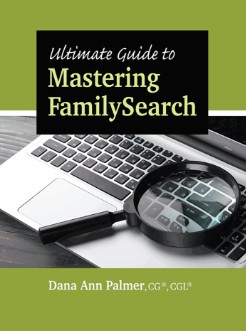
Ultimate Guide to Mastering FamilySearch Book Review


Available at Genealogical.com

Today’s blog is a book review of Ultimate Guide to Mastering FamilySearch by Dana Ann Palmer. Long-time readers won’t be surprised to learn how this review came about; it was a classic Lorism moment.

Shortly before Christmas, during a snowstorm, my husband braved the walk to the mailbox while I stayed inside working on a client report. “You got a package,” he called. I wasn’t expecting anything; our Christmas gifts were already wrapped and stacked in a box waiting to be transported to one of our adult children’s homes on Christmas Eve. Curious, I abandoned my computer to investigate.

The return address was Genealogical Publishing Company, but I couldn’t recall ordering anything. Inside was Ultimate Guide to Mastering FamilySearch, along with a packing slip clearly intended for someone else. Confused, I emailed the publisher and received a quick reply: I could keep the book, and they’d look into the mix-up. After a couple of emails back and forth, I agreed to write a blog post about it.

Apparently, the universe really wanted me to have this book and you might want one, too.

This is a hefty volume and very much a “start here” guide for those who want to use FamilySearch.org but aren’t, as my husband affectionately calls me, “click-happy.” By that, he means fearless and impatient: I will boldly click my way through a new website without hesitation. If FamilySearch feels overwhelming or intimidating, this book is clearly designed for you.

It’s also well-suited for people who aren’t particularly comfortable with computers. The book is packed with screenshots showing exactly what the pages look like, so readers can follow along visually and reassure themselves they’re in the right place.

That visual-heavy approach did raise one concern, which I shared with the publisher: websites change. A lot. Screenshots age quickly, and I worried the book could become obsolete. I was told that updates would be posted on the publisher’s website if FamilySearch undergoes major changes. Problem solved.

If you’re a beginner but not much of a reader, no worries. Although the book runs 225 pages, most of that is screenshots, arrows, and visual cues. The actual text is limited. Follow the red arrows and you’ll be just fine.

My advice for everyone, regardless of experience level, is to start with the summary on page 222. It’s one of the strongest sections of the book and provides a solid overview. The Table of Contents and Index are also genuinely useful, especially for intermediate users who already know the basics and want to jump directly to specific tools.

I was surprised to see that the book includes information on CETs (Community Owned Trees), which are user-created trees donated to FamilySearch via GEDCOM. These are not the same as the global Family Tree that all users can edit. What isn’t stated and really should be is the usual caveat: like all online trees, errors happen. Beginners especially need to remember that information being recorded does not make it correct.

That said, CETs are typically created and donated by professional genealogists. Are they perfect? No. But they are far more likely to be compiled using the Genealogical Proof Standard and to be fully sourced. I plan to donate my own tree someday, assuming I ever finish my Great Britain research (sigh).

I was equally pleased to see extensive coverage of one of my favorite FamilySearch tools: the FamilySearch Wiki. This is an outstanding resource, particularly when used alongside a traditional search engine and AI tools. The Wiki is often the fastest way to determine what records exist, where they’re held, and what gaps remain. Not everything has been digitized, and the Wiki helps keep expectations realistic.

It’s important to remember that the Wiki is static, it changes only when FamilySearch employees update it. My recommendation is to start there, then move on to dynamic tools like search engines and AI to see what else might be available.

For intermediate users and above, the searching tricks in Chapter 3 are especially useful. We can all use a reminder to use Boolean searching effectively. The book also walks readers through FamilySearch’s AI-powered Full-Text Search tool. If you haven’t had success with it yet, the step-by-step instructions here are worth following. Full-Text Search, combined with DNA results, has helped me solve several brick walls in just the past year.

I was also glad to see a section devoted to Images, which was my favorite FamilySearch feature long before Full-Text Search existed and one I still rely on heavily. One thing I’d add, though, is a warning for beginners: microfilm collections can be confusing. To avoid waste, records from one locality may be followed immediately by entirely different record types from another place halfway around the world. It’s efficient, but it can definitely throw off someone new to the platform.

My only real suggestion for improvement is that the book should begin with a clear, step-by-step explanation of how to create a FamilySearch account. It isn’t difficult, but for users who don’t spend much time online, even that first step can be intimidating.

Ultimate Guide to Mastering FamilySearch does exactly what it promises: it walks beginners, patiently and visually, through a platform that can otherwise feel overwhelming. Its strength lies in its screenshots, structured guidance, and clear explanations of core tools, especially the Wiki, Full-Text Search, and Images.

If you’re new to FamilySearch, not especially tech-savvy, and prefer learning by seeing rather than reading, this book will likely feel reassuring and approachable. More experienced researchers may find it useful as a reference or refresher, though not groundbreaking.

In short: this is a visual instruction manual, not a methodology guide. Used wisely, it can help users get oriented and move in the right direction. Used uncritically, it risks reinforcing the idea that genealogy is about following arrows rather than evaluating evidence. As always, the tool is only as good as the researcher using it.

Available in both ebook and print through Genealogical.com.

Friday, August 15, 2025

The Summer of My Genealogical Discontent Lesson 7 –  Listening to the Pros (or Not)


AI Image

Today’s blog might seem to contradict last week’s post about how I regretted not joining genealogical organizations earlier. But hear me out—this is a different kind of lesson.

When I decided to take the leap and become a professional genealogist, I did what many of us do: I turned to the experts. Longtime professionals told me there were a few non-negotiables—complete certain online courses, pursue credentialing, and charge fees that, quite frankly, I knew my clients couldn’t afford.

I listened. I believed them. And honestly? It didn’t sit well with me from the start.

The first issue was the recommended online course. I was on a waitlist, which ended up being a blessing in disguise. I was working a job that had me traveling constantly across the country—there was no realistic way I could log in consistently at the scheduled times. I would’ve failed before I even started.

I also applied for credentials, and… well, that was a wake-up call. (You can read about that experience here.) My clients didn’t care about my professional journey. They didn’t ask about credentials. They didn’t want to know about my course plans or associations. They wanted answers. Period. That experience made me reevaluate what I actually needed to build a meaningful and sustainable business. As an educator, I value credentials to insure that somene is competent in their field and I planned to one day revisit genealogical credentializing (more to come soon!) but that step didn't impact my growing business.

Then came the topic of fees.

I understood the argument from those already well-established in the field. They were charging high rates and worried that my lower fees might undercut the “market.” I get it. I was the Big Lots to their Macy’s.

But charging what they charged didn’t feel right to me. I knew the people I wanted to help—those searching for answers, sometimes quietly and painfully—couldn’t afford boutique pricing. And that mattered more to me.

To this day, I still undercharge. And you know what? I’m okay with that. I’m at peace with that decision. And all those pros who once told me what I had to do? They’ve since retired from genealogy. Their path wasn’t mine.

Maybe they meant well. Or maybe they wanted to keep genealogy as a kind of exclusive club. But that’s not how I see it.

I believe everyone deserves access to their family history—for medical reasons, for breaking cycles, for healing, for honoring those who came before us. I believe in empowering people to understand their story.

That’s why I’ve learned to be who I am, not what others think I should be. It’s my business. I run it my way.

In last week’s post, I mentioned how I wished I’d had a mentor early on. Let me clarify that—I wish I’d had someone who listened to me. Someone who supported who I was and what I valued. Not someone trying to mold me into something else.

If you’re thinking about going pro, here’s my advice: Find someone you connect with. Someone whose values align with yours. Years ago, I turned down the chance to mentor someone in another state. This was pre-Zoom, and I wasn’t sure phone mentoring would be effective. I suggested she find someone local instead. I never heard from her again, and I still wonder if she gave up on genealogy altogether. That thought saddens me.

So if you have the passion and the desire to go pro—don’t let anyone stand in your way. Especially not someone telling you there's only one right path. Because in genealogy, just like in life, the best path is the one that feels right to you.

Friday, August 8, 2025

The Summer of My Genealogical Discontent Lesson 6 – Failing to join an organization


AI Image

I’ve had a passion for genealogy for as long as I can remember—I just didn’t know it had a name.

As a child, I was drawn to the family stories my grandmother told and captivated by her scrapbooks and photo albums filled with long-ago faces and forgotten events. The mystery of my paternal side, which no one ever discussed, only deepened my curiosity. As a teenager, I started searching for answers—but not knowing what I was doing, I didn’t get far. College and life pulled me away for a while.

When my first child was born, I eagerly opened the baby book—only to find I couldn’t complete the family tree. I knew my paternal grandparents, but beyond that? Nothing. My dad told me he’d give me a family book I hadn’t known existed—someday. But when that day came, and he passed, the book never made its way to me. My stepmother found it too much trouble to mail.

So I turned to the internet, which was just beginning to bloom, and took a beginner class at a local Church of Jesus Christ of Latter-day Saints. In hindsight, what I really needed back then was a mentor—someone to show me the ropes, answer my endless questions, and guide me along the path. I should have joined a local or national organization. But with a full-time job, kids to raise, elders to care for, a house to run—and no extra money to spare—I didn’t.

Instead, I used every scrap of free time to work on my tree. I shared my excitement with colleagues, though most didn’t understand why I’d spend vacation time at the Family History Library in Salt Lake. Still, when they had family mysteries, they came to me. I happily helped, and they were amazed at what I uncovered.

More requests came in. I never charged a cent—it never occurred to me to think of myself as a professional.

Then one day, a former boss told me, “You know, people would probably pay you to do this.” I was stunned—and, honestly, panicked. I thought he was letting me go and hinting I should start a business in the middle of a recession. He laughed and clarified: “You’re very good at this. You could turn it into something real.”

I set that thought aside. Life was already complicated.

But as the kids grew up and moved out, I finally had more time—and a little more money. I joined a local society and two national organizations. I attended conferences, subscribed to journals, and slowly built my confidence. I chose a name for my business: Genealogy At Heart, because I wanted to focus on what I loved—helping people uncover those sensitive family secrets. With my background in education and counseling, it was a natural fit.

What I didn’t know? That there were resources out there to help me from the start. I hadn’t heard of SCORE, a free business mentoring service. I didn’t know about the Association of Professional Genealogists, which offers tools, advice, and a sense of community. Had I joined an organization earlier—whether a local society or a national group—I would have had a much smoother beginning as a business owner.

Genealogy can feel like a solitary pursuit. We stay up late combing through records, take solo road trips to distant archives, and keep quiet at family gatherings to avoid the eye rolls. But it doesn’t have to be lonely. And it shouldn’t be.

Today, I’m actively involved in several genealogical organizations. They’ve helped me refine my research, consult with experts, and become a better genealogist—not just for clients, but for my own family, too. I no longer rely solely on myself, and I’ve learned that collaboration isn’t a luxury—it’s a strength.

Looking back, I can only imagine how much further I’d be if I’d learned this lesson sooner. But I’m glad I did.

When the Tombstones Disappear

  Genealogists spend much of their time searching for things that have been lost. Missing records. Forgotten stories. Unmarked grav...