Showing posts with label Kos. Show all posts

Friday, May 22, 2026

Lost in Translation: When Names Refuse to Behave


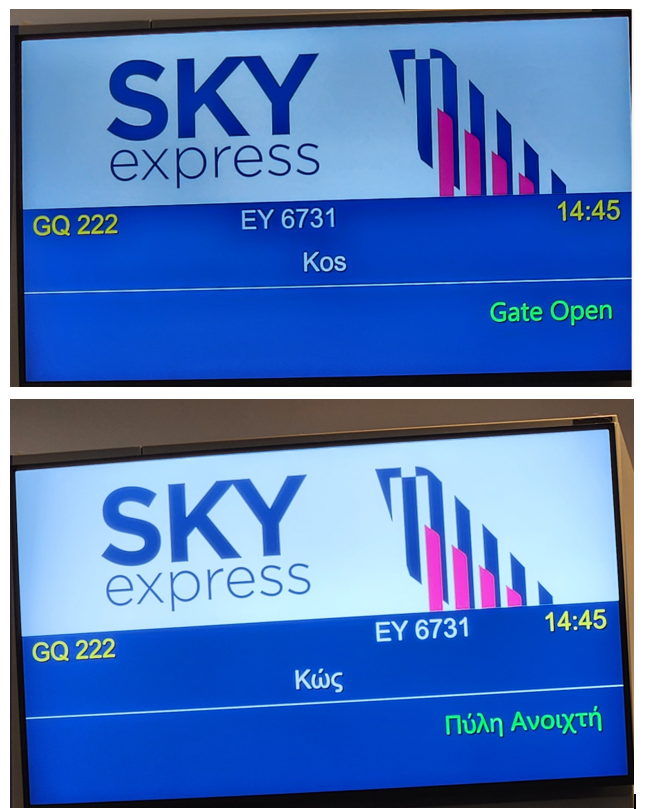
Photo by Lori Samuelson, Athens Airport, 3 April 2026.

I wasn’t expecting to be tripped up by my own name.

Not in an airport. Not in 2026. Not after years of working with records, languages, and historical documents.

And yet, there I stood, staring at a screen, absolutely certain something was wrong… because my name wasn’t spelled correctly.

Except, it was.

Travel has a way of reminding us that names are not as fixed as we think they are.

As genealogists, we’re trained to look for variation:

  • Smith / Smyth
  • Miller / Müller
  • Johnson / Johansson

We nod along, we teach it, we write about it.

And then suddenly, there it is, happening to us in real time.

In the airport, my name appeared in a way I didn’t immediately recognize. The letters were familiar, but not quite right. Some were substituted. Others seemed to shift in ways that made my brain hesitate. For a brief moment, I did what we’ve all done at some point in research: I assumed it was wrong.

But it wasn’t wrong. It was simply… written differently.

Names don’t just change over time, they change across languages, alphabets, and systems.

What we often call “Anglicization” is only one small part of a much bigger reality.

Because sometimes names aren’t Anglicized at all.

They are:

  • Transliterated (converted between alphabets)
  • Phonetically interpreted by someone unfamiliar with the language
  • Standardized by a government or institution
  • Digitally altered by systems that don’t support certain characters

Think about it:

A name written in:

  • Greek
  • Cyrillic
  • German with umlauts
  • Croatian with diacritics

…doesn’t always have a one-to-one match in English.

So what happens? The system makes a choice and that choice isn’t always the one you expect.

At that airport, I realized something important.

I was reacting the same way many researchers do when they encounter a record that doesn’t match their expectation:

“That can’t be right.”

But it can be right. It just isn’t familiar.

This is where genealogical research either stall or moves forward.

Because if we insist on one spelling, one version, one “correct” form of a name we will miss records.

Names shift in predictable and unpredictable ways:

  • Letters are substituted based on sound
  • Endings are adapted to fit grammar rules
  • Characters are dropped when they don’t exist in another language
  • Entire spellings are reshaped to fit a new cultural context

And sometimes? They’re just recorded however someone heard them.

The lesson isn’t new but experiencing it firsthand changes how you approach it. From that moment on, I wasn’t just telling people:

“Look for variant spellings.”

I was thinking:

“How would this system have interpreted this name?” Because that’s the real question.

Not:

  • What is the correct spelling?

But:

What versions of this name could exist in this context?

Whether you’re working in:

  • immigration records
  • church registers
  • court documents
  • or modern travel systems

…the principle is the same.

Names are not static. They adapt. They shift. They survive. Sometimes, they surprise you, right there in an airport, when you least expect it.

If there’s one takeaway from that moment, it’s this:

Don’t search for your ancestor’s name.

Search for the ways it could have been written.

Because somewhere, just slightly altered, slightly unfamiliar, your answer is waiting.

Friday, October 11, 2024

Daniel Hollingshead and a Connection to My Eastern European Relatives


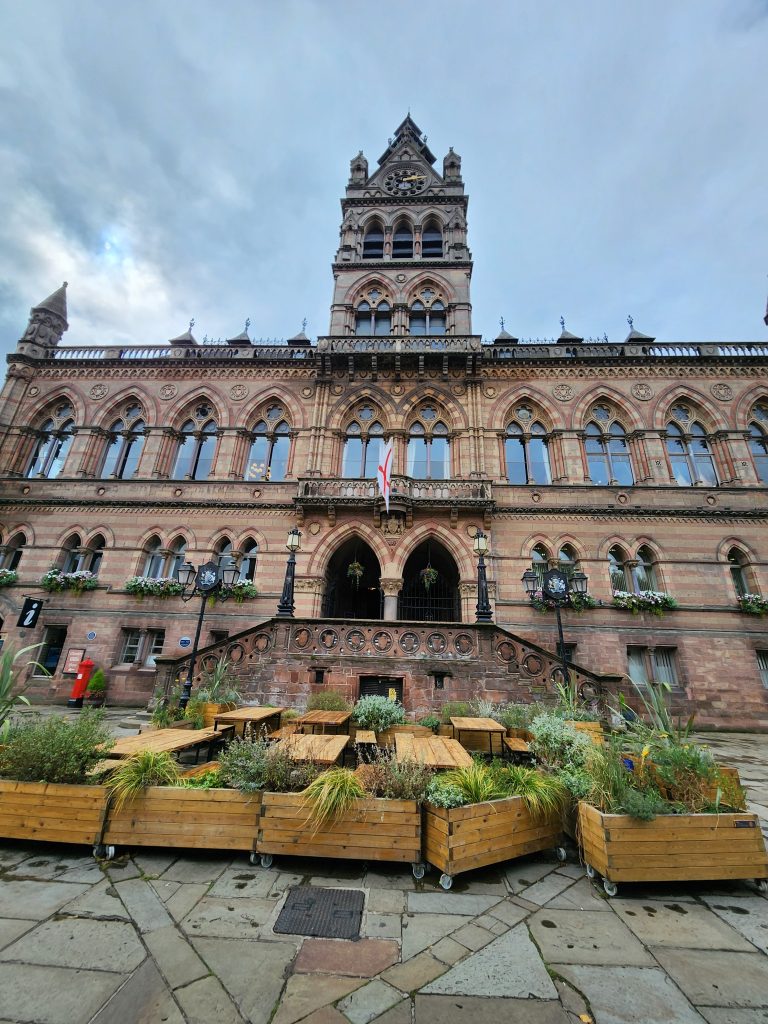
Chester City Hall, Photo by Lori Samuelson

Last week I blogged about how I had first discovered my 7th great grandfather, Daniel Hollingshead and the strange migration that both he and one of my adult children had followed. The story continues...

Daniel was born in 1686 in Saxelby, Leicestershire, England. On my recent visit to Great Britain I made a stop in Chester. Daniel's grandfather Francis was born in Chester in 1622 but emigrated to Saxelby by age 18. Court records show that he returned to farm in Chester but after a contagion, returned to live in Saxelby. There he became a collector of hearthmoney. Unfortunately, Francis became ill and sub contracted his hearthmoney collection job to two other men. Those men absconded with the money. Francis died at age 53 in 1675.

Francis's wife, Marie, was left with four children to support, a large debt to the crown, and not a lot of options. Court records show that she provided her dowry as partial repayment and one Frances's brothers, Ralph Hollingshead, provided the remainder of the funds as he was receiver of securities for Chester.

From court records it appears that whoever in the treasury accepted the money also absconded with it. Ralph then joined the military and shipped out to Barbados. Marie's son, Francis Jr., at age 25, was able to convince the courts that the money had been repaid to the crown but stolen internally. He was then given the job as collector of hearthmoney.

Francis Jr. was Daniel's father. Although these troubling events occurred before Daniel was born it no doubt had an effect on him. Daniel was the third surviving son in the family and knew his fortunes lay outside of Saxelby. Likely that is why he joined the military like his great uncle Ralph. Daniel, following in Ralph's footsteps, ended up in Barbados.

While in Chester I stopped at the public library to see if I could find anything on the Hollingshead. The collection is small and the only finds were about a distant relative, Raphael Hollingshead who was famous for writing a history of England. Disappointed, I traveled onward.

Perhaps my interest stirred the spirit world or perhaps what followed was a simple synchronocity. I don't know - you be the judge.

When I returned home I received an Ancestry.com message from a Hollingshead relative. I have NEVER before had anyone from this line write to me so I was delighted, especially since I had just visited the old family stomping ground.

I was surprised to learn that this "new" cousin lived in the next county from me when I lived in Florida for 50 years. We often visited the beach where he lives a mere 4 miles from. But it gets weirder...

In our typing back and forth he mentioned that his ethnicity is also part Austria-Hungarian. I share that on my maternal line as he does. Then things got really strange.

I asked if he was Croatian but his response stunned me. No, he was Magyar. Unbeknownst to him, I was going to present at the 36th International Congress of Genealogical and Heraldic Sciences in Boston the following week on the plementi ljudi (pl) nobility. The original pls were of Magyar ethnicity. After King Louis II of Hungary died, the area was acquired by the Austrian Hapsburgs who increased the number of pls in defense of cities since this was the time of the Ottoman War. My Croatian Kos and Grdenic family became pls during this time. What a weird connection to my new distant cousin - a Great Britain ancestor and a nobility title from Eastern Europe!

Typically in October I blog about the wonderfully odd happenings I experience throughout the year. This week, I will be heading to Germany and France to walk in my husband and my ancestral steps. No blog next week due to my travels. One more synchronicity will be published the last weekend in October.

What the Neighbors Can Tell You

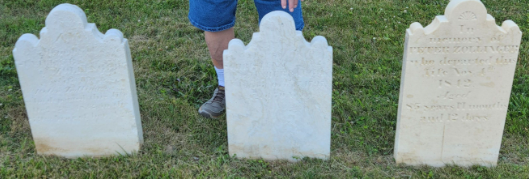
  St. John's United Church of Christ Cemetery, Sabillasville, Frederick, Maryland. Christina Weller Harbaugh in between two other stone...