Friday, September 25, 2026

I’m Heading Across the Pond Virtually! All About That Place 2026


I’m delighted to share that I’ll be taking part in an international genealogy event this October with the Society of Genealogists’ All About That Place 2026!

Running from 07–16 October 2026, All About That Place brings together more than 150 speakers for almost 200 FREE, bite-sized presentations devoted to genealogy, local history, research techniques, archives, social history, technology, and the places that shaped our ancestors’ lives.

And I’m involved in more ways than one this year!

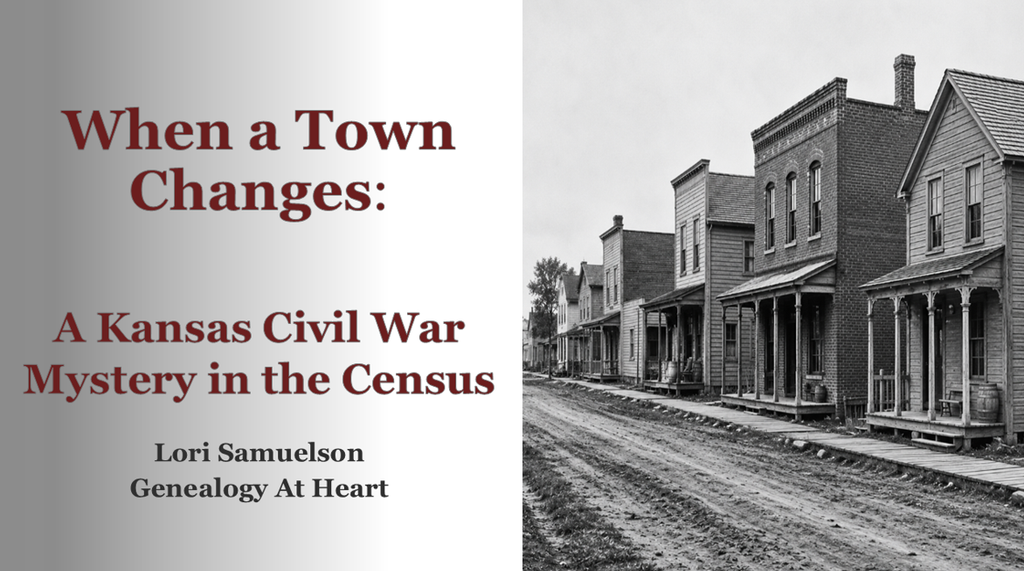
My presentation is titled “When a Town Changes.”

Genealogists naturally spend a great deal of time looking for people. But sometimes the place itself is part of the evidence.

Towns change names. Boundaries shift. Communities disappear. Streets are renamed. Industries arrive and vanish. Populations move. The place we find on an ancestor’s record may look very different today and occasionally understanding what happened to the place is exactly what we need to understand what happened to the people who lived there.

That is the idea behind my 10-minute presentation.

My talk is part of the “Changing Places” theme of All About That Place, and I hope it encourages researchers to look beyond the names and dates in their family trees and ask another question:

What was happening to the place where my ancestor lived?

WATCH PARTY — 13 OCTOBER 2026

I’ll also be holding a Watch Party at noon Eastern Time on 13 October. If you’d like to watch “When a Town Changes” with me, mark your calendar! I’d love to have some familiar faces joining genealogists from around the world.

AND THERE’S A PRIZE! I’ve donated a short private genealogy consultation as one of the prizes for All About That Place.

That means one participant will have an opportunity to Zoom with me and talk through a genealogy problem, research question, brick wall, or next step. I’m looking forward to meeting the winner and seeing what mystery they bring me!

I’M ALSO ON THE FAMILY HISTORIES PODCAST. There’s one more part of this adventure that I’m especially excited about. I recently sat down with the host of The Family Histories Podcast to record a special All About That Place episode. We talked about my research and some of the stories and challenges that come with trying to reconstruct the lives of people who can no longer tell us what happened themselves.

The episode is being released worldwide through Apple Podcasts, Spotify, YouTube, Audible and other podcast platforms, and it will also be available directly from The Family Histories Podcast website.

Listen here:

The Family Histories Podcast

COME JOIN US! IT’S FREE!

One of the things I love about All About That Place is its format. These aren’t hour-long lectures. The presentations are just 10 minutes each, which means you can explore a subject, discover a new researcher or technique, and then move on to something completely different.

Best of all, the main All About That Place program is FREE.

You can learn more about the event, see the speakers and explore the program through the Society of Genealogists:

All About That Place 2026 — Society of Genealogists

I hope you’ll join me on 13 October for “When a Town Changes.” And while you’re there, take a look through the rest of the program. With nearly 200 talks, I suspect most of us will discover more than a few we simply have to watch.

See you there!

Wednesday, September 23, 2026

RE: NARA Notice 2026-037 — Closure of the National Archives at Chicago and the National Archives at San Francisco (San Bruno)

An open letter to my Indiana Congressman and Senators:

I am writing as a professional genealogist, author, educator, and researcher to express my deep concern about the announced closure of the National Archives at Chicago and the National Archives at San Francisco in San Bruno.

For those of us who work with historical records, an archive is not simply a building in which records are stored. It is the place where evidence becomes accessible.

That distinction matters.

I have spent years researching families whose stories cannot be reconstructed from records found online. Despite the extraordinary growth of digitized collections, anyone who conducts serious genealogical or historical research knows that enormous quantities of federal records remain available only in their original form. NARA itself holds billions of pieces of paper. Moving an undigitized record hundreds of miles away may preserve the document physically, but it can place that document effectively beyond the reach of many of the people who need to consult it.

That is particularly troubling to me as an Indiana researcher. The National Archives at Chicago serves Illinois, Indiana, Michigan, Minnesota, Ohio, and Wisconsin. Its records document the lives of people throughout the Midwest through federal court files, naturalization and immigration records, Bureau of Indian Affairs materials, maritime records, federal agency records, and countless other collections.

These are not merely records about government. They are records about people.

They contain the immigrant seeking citizenship, the sailor working the Great Lakes, the family appearing in federal court, the Native American interacting with a federal agency, the worker whose life intersected with federal law, and ordinary men and women who may have left very little evidence of their lives anywhere else.

Genealogists understand something particularly important about records such as these: we often do not know what we need until we see it.

A catalog description cannot tell us everything contained in a box. An index cannot reproduce marginal notes, attachments, correspondence, photographs, affidavits, or neighboring documents that provide context. And a digitized image cannot help when the record has never been digitized.

I recognize that NARA faces legitimate challenges involving aging facilities, declining storage needs for temporary paper records, and the federal government's transition to electronic recordkeeping. NARA has explained that these considerations contributed to the decision to close Chicago and San Bruno. But the changing needs of the Federal Records Centers should not automatically determine the future accessibility of the permanent archival records housed alongside them.

Those are two different questions.

Before permanent archival holdings are dispersed, I urge NARA and Congress to consider whether regional public access can be preserved, even if maintaining the present buildings is no longer practical. If these particular facilities cannot reasonably remain open, then suitable alternatives within the regions they serve should be seriously explored.

I also urge NARA to provide researchers with clear information about what will happen to each collection, where it will be housed, when it will become unavailable for research, when access is expected to resume, and what provisions will be made for researchers who can no longer reasonably travel to the new location.

For a researcher in Indiana, moving a record from Chicago to Kansas City is not simply changing its shelf location. It changes whether that record can realistically be examined.

The National Archives has an extraordinary responsibility. It preserves the documentary evidence of the federal government, but preservation alone is not enough. Records must also remain meaningfully accessible to the American people whose history they document.

Once regional archival infrastructure disappears, recreating it will be extraordinarily difficult.

I therefore respectfully ask NARA to pause the closure and relocation process long enough for meaningful consultation with researchers, genealogical and historical organizations, tribal nations, educators, affected communities, and members of Congress. I also ask Congress to examine whether adequate alternatives exist for maintaining regional access to these permanent federal records before the present facilities are closed.

Our nation's records belong to all of us. Their value lies not simply in keeping them safe, but in ensuring that future generations can find them, examine them, question them, and use them to understand the people who came before.

As a genealogist, I see every day what happens when a record survives.

I also know what happens when access to it disappears.

Respectfully,

Lori Samuelson

READERS: You have my permission to forward or alter this letter in anyway you'd like. Contact your representatives. They are SUPPOSED to listen to us. Here's the link to find your Congressperson and Senators.

Friday, September 18, 2026

Book Review: Echoes in the Blood

Dick Robinson’s Echoes in the Blood: How the Past Lives On in Us is an unusual combination of genealogy, family memoir, history, and reconstructed narrative.

Robinson’s research led him to connections, by blood and through marriage, with a collection of historical figures, including Abraham Lincoln, Helen Keller, Martin Luther King Jr., Winston Churchill, William Shakespeare, Isaac Newton, and Elvis Presley. He presents these discoveries as something more than famous names, looking for patterns of struggle, resilience, loss, service, and family influence that seem to recur across generations.

What makes the book particularly interesting to genealogists is Robinson’s approach to storytelling. He openly explains that while the relationships and historical framework are documented, some scenes are reconstructed and dialogue is imagined. He identifies those passages through gray shading and tells readers that artificial intelligence assisted with organization, clarification, and editorial refinement.

I appreciated that transparency, although it raises an important question: How far can a family historian go in reconstructing a scene before genealogy becomes historical fiction?

Robinson tells us the difference, but his scenes can be vivid enough that the boundary becomes surprisingly easy to cross as a reader.

The book is written in an intentionally unconventional style, using short sentences, fragments, and sometimes individual words to create rhythm and emphasis. That works particularly well during dramatic moments.

Interestingly, the famous historical figures were not always the people I found most compelling. Robinson’s own relatives, including Augusta Burnett, Elizabeth Robinson, and his father, Francis Robinson, often interested me more. His discussion of a family member's prejudice is particularly thought-provoking because Robinson recognizes that families can transmit attitudes and fears along with the more admirable qualities we prefer to celebrate.

That, for me, is where Echoes in the Blood becomes most successful.

Genealogy is not simply about discovering whom we descend from or which famous person appears somewhere on our tree. It is also about asking what families carry forward and what later generations choose to preserve, change, or reject.

Family history offers wonderful opportunities for storytelling, but storytelling cannot substitute for evidence. Robinson states that the relationships presented in Echoes in the Blood have been verified and later discusses the Genealogical Proof Standard. For me, that makes the documentation especially important. The online compiled trees cited in the endnotes may provide useful clues, but they do not, without evaluation of their underlying evidence, demonstrate the relationships claimed. Readers should therefore approach the genealogical connections in this book as avenues for further research rather than as proved relationships.

Echoes in the Blood left me with a question that genealogists increasingly need to consider, particularly as AI becomes part of our writing process: How do we make our ancestors live again on the page without inadvertently creating lives they never lived? That question alone makes this an interesting book for genealogists to discuss.

Disclosure: I received a complimentary digital copy from the author; no conditions were placed on this review

Source: Dick Robinson, Echoes in the Blood: How the Past Lives On in Us (Boynton Beach, FL: Legacy Scribe Books, LLC, 2026).

Friday, September 11, 2026

3. Building Your Genealogy AI Assistant


For the past two weeks I’ve been blogging about the importance of personalizing your AI. Last week I wrote how to accomplish that with ChatGPT. Even if you only have a free version, it’s important for you to customize. I also strongly encourage you to have a free account with all of the AIs so you can check their work as some are stronger in one area than another.

Here’s how to personalize with

CLAUDE:

Click on the lower left circle that is your profile icon. Select Settings. Click General. In the box, tell Claude your instructions to use every single time you being a chat.

GEMINI:

Click on the lower left profile icon. Then click on the right setting icon for new pop up window seen above, look for Personal Intelligence. Next click Instructions for Gemini. Insert your instructions in the box.

PERPLEXITY:

Like, ChatGPT and Claude, click on the lower left profile icon then click Account. Next click Personalization. Complete the information under Custom Instructions

CHATGPT:

Information can be found here.

Now you've saved yourself from having to retype the same instructions repeatedly. Remember, if you provide a conflict in an instruction in the chat box from what you've written under personalization, no worries! The prompt box will override what you have in personalization. If you do find yourself having to give the AI repeated instructions, then go back to the personalization setting and update. Happy Researching!

Saturday, September 5, 2026

2. Customizing ChatGPT: The Five Minutes That Will Save You Hours


In my last article, I explained why every genealogist should customize their artificial intelligence assistant before asking it to help with research. Think of it as introducing a new research assistant to your way of working.

Now let's put that idea into practice with ChatGPT.

The entire process takes only a few minutes, yet it can dramatically improve the quality and consistency of the responses you receive.

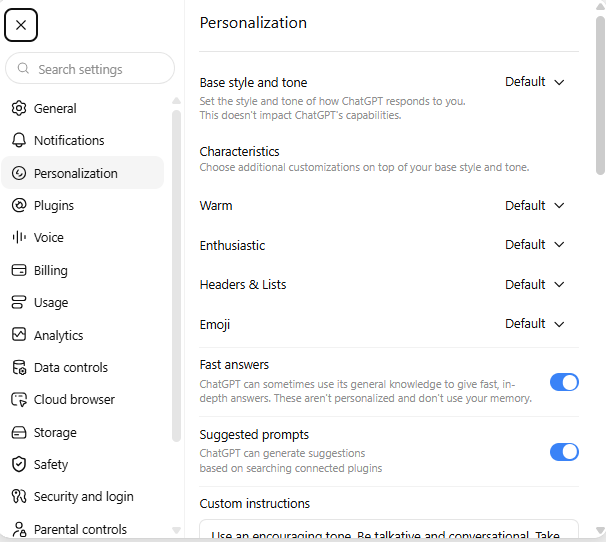
Step 1: Open Your Settings

Sign in to ChatGPT.

Select your profile icon in the lower left corner of the screen, clicking on the circle.

From the dropdown, select Personalization. This is where you'll find the options that allow ChatGPT to adapt to the way you work.

Click on Personalization and scroll down to the box under Custom Instructions. That's where you will put in your directions.

Step 2: Tell ChatGPT About Your Work

Don't write a biography.

Instead, tell ChatGPT what it needs to know in order to work effectively with you.

For example, you might include:

• I am an intermediate genealogist researching families in Ohio and Pennsylvania.

• I prefer Chicago-style source citations.

• Always distinguish between facts, evidence, assumptions, and hypotheses.

• Never invent missing information.

• State clearly when evidence is inconclusive.

• Use military-style dates such as 21 March 1850.

• Write in a conversational but professional tone.

Notice that none of these instructions reveal private information. They simply describe how you want your AI assistant to approach its work.

Step 3: Explain How You Like Information Presented

Formatting matters.

If you frequently ask ChatGPT to create timelines, research plans, proof summaries, tables, or blog posts, mention that in your instructions.

For example:

"I prefer timelines arranged chronologically."

"Separate proven facts from working hypotheses."

"Use headings and short paragraphs for readability."

The more consistently you work, the more useful these instructions become.

Step 4: Don't Try to Tell It Everything

One mistake I often see is people creating pages and pages of instructions. My research assistant, Geni, informed me that someone uploade 60 pages here.

Resist the temptation.

Long instruction lists often include information that is rarely used or eventually becomes outdated.

Instead, include only those preferences that affect most of your conversations.

You can always provide additional instructions for a particular project when needed.

Don't forget to hit SAVE!

Step 5: Update Your Settings Over Time

Your settings should evolve.

Whenever you notice yourself making the same correction repeatedly, consider adding that instruction to your saved preferences.

Perhaps you always ask ChatGPT to avoid speculation. Maybe you repeatedly remind it to cite sources or to identify conflicting evidence.

If you're saying the same thing over and over, your settings probably need an update.

Remember: Settings Are Not Magic

Custom instructions improve consistency, but they do not replace careful review.

I still verify every citation, read every record myself, and evaluate every conclusion before I publish or share it with a client.

AI is an assistant, not a substitute for genealogical judgment.

A few minutes spent customizing ChatGPT today can save hours of rewriting tomorrow.

In the next article, we'll compare how Gemini, Claude, and Perplexity allow you to personalize their responses and discuss which features are most useful for genealogists.

I’m Heading Across the Pond Virtually! All About That Place 2026

  I’m delighted to share that I’ll be taking part in an international genealogy event this October with the Society of Genealogists’ Al...