Showing posts with label Hollingshead. Show all posts

Friday, October 17, 2025

The Hidden Discoveries of Writing Your Research


AI Image

As genealogists, we spend hours pulling records, analyzing handwriting, and piecing together family connections. Most of that work happens in the collecting stage, we hunt down wills, census pages, land deeds, and church registers. But it isn’t until we write that we begin to see what those records are really telling us.

Writing forces a shift in how our brains work. Collecting records is like gathering puzzle pieces. Writing is when you finally flip the pieces right-side up and begin to see the picture. Patterns emerge that you hadn’t noticed before. Gaps in the timeline become obvious. A stray witness on a deed suddenly matters because you’re weaving the story instead of cataloging the fragments.

I saw this firsthand with my ancestor Daniel Hollingshead. I had collected a mountain of records: tax documents from Cheshire, court cases, marriage records from Barbados, and family land deeds in New Jersey. It wasn’t until I began to write his story that the threads pulled tight. Suddenly, the narrative was clear:

  • A grandfather’s failure as a tax collector plunges the family into crisis.
  • An uncle flees to Barbados after funds are stolen.
  • A young Daniel joins the military, is posted to Barbados, and marries into sugar wealth.
  • He returns to New Jersey with enslaved people, rising socially but carrying moral shadows with him.

The facts were always there in the records. But the story, the irony, the Atlantic World connections, the moral reckoning , only emerged when I tried to explain it in writing.

That’s the hidden power of writing: it doesn’t just preserve what you’ve learned, it teaches you something new. Writing sharpens your research questions, reveals new avenues to explore, and brings ancestors to life in ways a database never can.

So the next time you feel stuck in the research grind, try writing a short biography or family sketch. Even a rough draft will show you what you’ve missed. You might be surprised at what discoveries are hiding , not in the archives, but in your own words.

Friday, October 11, 2024

Daniel Hollingshead and a Connection to My Eastern European Relatives


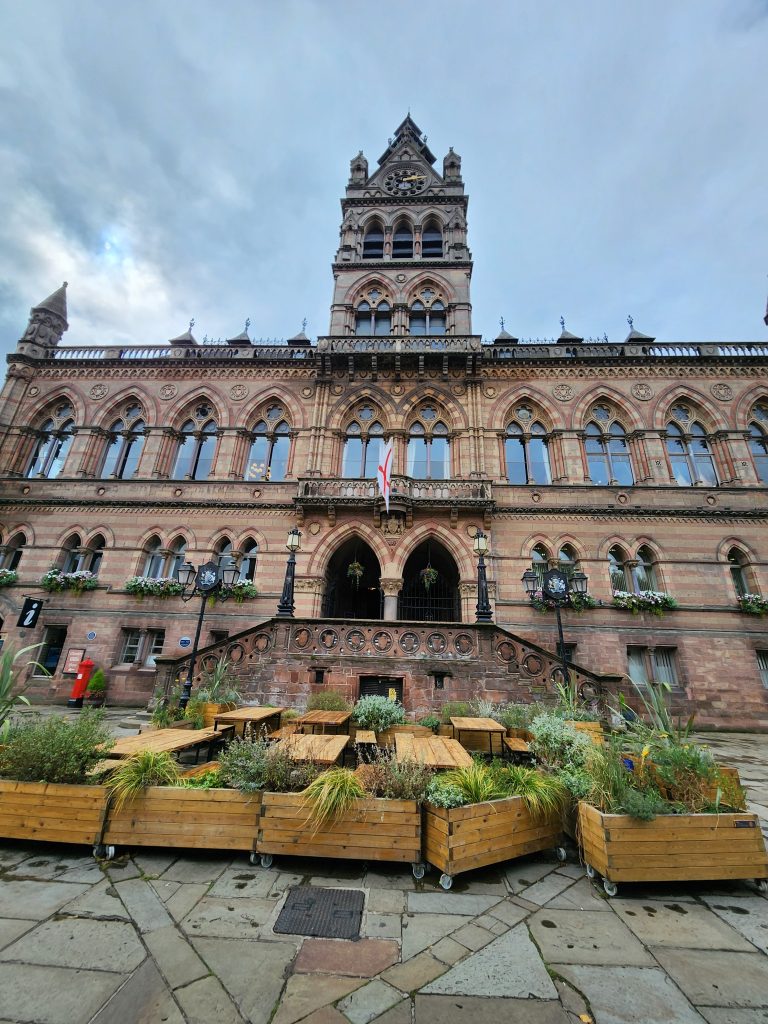
Chester City Hall, Photo by Lori Samuelson

Last week I blogged about how I had first discovered my 7th great grandfather, Daniel Hollingshead and the strange migration that both he and one of my adult children had followed. The story continues...

Daniel was born in 1686 in Saxelby, Leicestershire, England. On my recent visit to Great Britain I made a stop in Chester. Daniel's grandfather Francis was born in Chester in 1622 but emigrated to Saxelby by age 18. Court records show that he returned to farm in Chester but after a contagion, returned to live in Saxelby. There he became a collector of hearthmoney. Unfortunately, Francis became ill and sub contracted his hearthmoney collection job to two other men. Those men absconded with the money. Francis died at age 53 in 1675.

Francis's wife, Marie, was left with four children to support, a large debt to the crown, and not a lot of options. Court records show that she provided her dowry as partial repayment and one Frances's brothers, Ralph Hollingshead, provided the remainder of the funds as he was receiver of securities for Chester.

From court records it appears that whoever in the treasury accepted the money also absconded with it. Ralph then joined the military and shipped out to Barbados. Marie's son, Francis Jr., at age 25, was able to convince the courts that the money had been repaid to the crown but stolen internally. He was then given the job as collector of hearthmoney.

Francis Jr. was Daniel's father. Although these troubling events occurred before Daniel was born it no doubt had an effect on him. Daniel was the third surviving son in the family and knew his fortunes lay outside of Saxelby. Likely that is why he joined the military like his great uncle Ralph. Daniel, following in Ralph's footsteps, ended up in Barbados.

While in Chester I stopped at the public library to see if I could find anything on the Hollingshead. The collection is small and the only finds were about a distant relative, Raphael Hollingshead who was famous for writing a history of England. Disappointed, I traveled onward.

Perhaps my interest stirred the spirit world or perhaps what followed was a simple synchronocity. I don't know - you be the judge.

When I returned home I received an Ancestry.com message from a Hollingshead relative. I have NEVER before had anyone from this line write to me so I was delighted, especially since I had just visited the old family stomping ground.

I was surprised to learn that this "new" cousin lived in the next county from me when I lived in Florida for 50 years. We often visited the beach where he lives a mere 4 miles from. But it gets weirder...

In our typing back and forth he mentioned that his ethnicity is also part Austria-Hungarian. I share that on my maternal line as he does. Then things got really strange.

I asked if he was Croatian but his response stunned me. No, he was Magyar. Unbeknownst to him, I was going to present at the 36th International Congress of Genealogical and Heraldic Sciences in Boston the following week on the plementi ljudi (pl) nobility. The original pls were of Magyar ethnicity. After King Louis II of Hungary died, the area was acquired by the Austrian Hapsburgs who increased the number of pls in defense of cities since this was the time of the Ottoman War. My Croatian Kos and Grdenic family became pls during this time. What a weird connection to my new distant cousin - a Great Britain ancestor and a nobility title from Eastern Europe!

Typically in October I blog about the wonderfully odd happenings I experience throughout the year. This week, I will be heading to Germany and France to walk in my husband and my ancestral steps. No blog next week due to my travels. One more synchronicity will be published the last weekend in October.

Saturday, March 16, 2024

10 Million Names Enslaved Project

AI Generated


Do you have enslaved or enslavers in your family tree? If so, your research is needed in support of the 10 Million Names Project. The project is supported by the New England Historic Genealogical Society (American Ancestors) to create a FREE searchable online database of the estimated 10 million people of African descent who were enslaved between the 1500s-1865.

I submitted to the project an updated report I had done on one of my ancestors, Daniel Hollingshead. I've blogged about Daniel previously here, here, here, here, and here. I don't want my research to be lost and I want it to be of value to others so I updated a report I wrote about Daniel and uploaded it to the project.

Here's the link to the website. It's simple to contribute! I saved my report as a .pdf, clicked "I'd like to upload family notes or a genealogy," typed in my email, what the submission was regarding (info about enslaved and enslavers), typed in the title, added a brief description of what I was uploading, clicked that I agree to share, and then attached my report. Don't forget to press Send! I received a submission number and and an email confirming the information was received.

You may have seen the recent RootsTech talk about this project. Now you can be a part of it!


Saturday, February 18, 2023

Duer Dilemmas

My long-time readers know my obsession with the Duer family. I've been good, though, and haven't blogged about them in almost two years. Honestly, I have not researched their lines since the pandemic was full throttle. Last month I watched a Legacy Family Tree presentation by Elizabeth Shown Mills who is, lucky for us, back from retirement. The lecture gave numerous ideas on how to problem-solve using "trivial details." A comment she made resonated with me; there are going to be times that we will NEVER find a document that clearly establishes a relationship. I'm one of those genealogists that believe that somewhere, somehow, that long-sought record will unveil itself and leave me with a happy ending. Too many Disney movies, I guess! The lecture made me come to my senses. It was time for me to resurrect, review, and re-analyze all of my Duer findings and move toward a conclusion. Briefly, my 5th great grandfather, John Duer (1748-1831), died after my 4th great grandfather, Thomas Duer (1775-1829) so Thomas and his family were omitted from John's will. Another daughter of John's who had died early was also omitted, however, her only son was named in John's will. None of Thomas' children were named. Thomas had died intestate (of course). The family originated in New Jersey; only one document there ties John and Thomas together but doesn't state a relationship. That document was both men witnessing a will for a neighbor. John is found in a deed in what is now West Virginia. He made the purchase in 1792 but didn't move until about 1797. By 1805 he was in Trumbull County, Ohio. As was Thomas. There is no deed for either John or Thomas in the early years in Ohio but they are on tax lists, next to each other. Property maps show them residing next to one another. And that is all I have. Not! Using what Mills discussed, I pulled out every document I had for both men and created a different timeline than I had previously done. This time I made 5 headings - Date, Event, Place, Source(s), and Name. I began with the earliest records I had for John. Some of the sources, I'll admit, are stinky like this for birth - http://familytreemaker.genealogy.com/users/b/e/a/Scott-C-Beal/GENE4-0004.html (no source) - though I recorded each as together, clues are provided. In the Name column, I recorded who was named in the record. The few that showed John and Thomas together I highlighted in pale green. I then went through Thomas's records and fit them into the same timeline in chronological order. This is where I realized there were many more connections between the two men - guardianship of Thomas' children, land sales among the surviving family members, and religious affiliation. I highlighted those in pale orange. Yes, it is an ugly color scheme but it does stand out. I then wrote 9 pages of relationship proof. It also includes DNA. My plan is to share this with colleagues over the next few weeks for their insight. Possibly, I'll be publishing it, too. I may even approach a lineage society and complete an application. My husband remarked, "So, you're now done with the Duers." I thought, "Is one ever done with a line?" You know the answer. No, in analyzing the John-Thomas information I noticed some very interesting (to me!) nuances. I decided to take on a major Duer surname study of the New York, Antigua, and possibly Connecticut lines in the hope of identifying their shared relative. Clearly, they all had a shared relationship both in the Caribbean and in the Colonies. It also involves John Duer's maternal grandfather, Daniel Hollingshead, who I have written extensively about. During the pandemic, I was able to find how Daniel, a Presbyterian, was related to the Quaker line. I was unable to understand his relationships with the New York Duers who married into the Alexander family, as Daniel did, but those Alexander families don't seem to connect, either. It is a convoluted mess! As you can see by the tree shown at the top of the page, every generation of every line has a John, Thomas, William, and Daniel. And, they intermarry. And, they don't leave a lot of records. And researchers confuse them, particularly the Ohio and Pennsylvania John's Revolutionary War Service. It's going to be fun to sort this all out so look forward to more blogs about my Duer Dilemma!

When the Past Finds You

  Jim and Lori on Kos Island, Greece Last week, I shared my husband’s strange encounter with the universe. This week, it’s my turn. ...