Sometimes genealogy has a strange sense of humor.
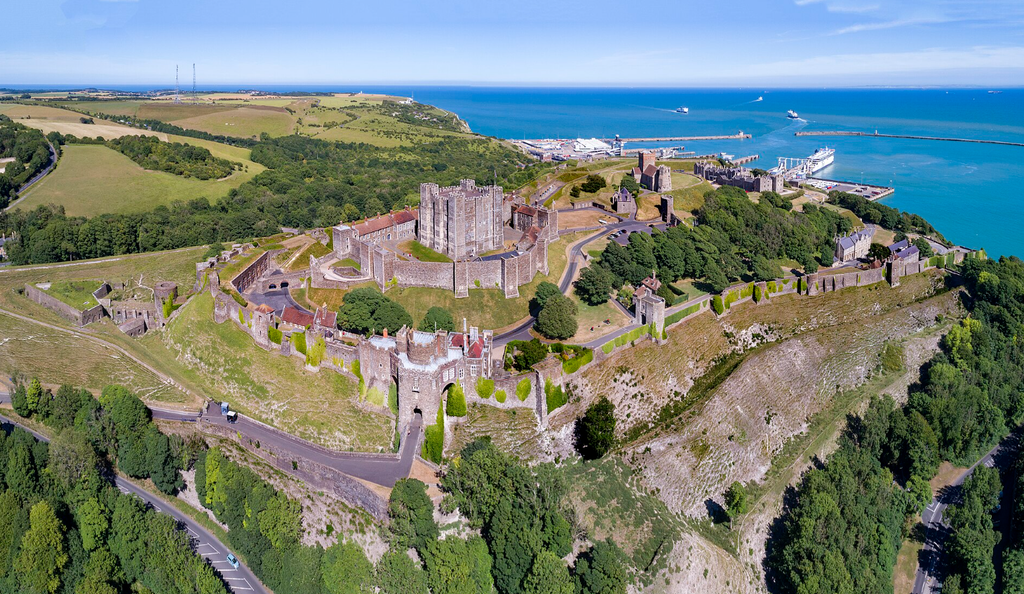
I was recently working on the medieval lines of my family tree when I found myself repeatedly returning to one place: Dover Castle in Kent, England.
This was not a new discovery. Various branches of my family had connections with Dover over several generations. Some held land requiring service for the guard of the castle. Sir John Grey served as its constable. Another John Grey held land of the king in chief in 1312 by service connected with the guard of Dover Castle. The Badlesmere family also had longstanding obligations associated with its defense.
Then there was my ancestor Bartholomew de Burghersh. His connection was particularly strong. He served as Constable of Dover Castle and Warden of the Cinque Ports, and he died at Dover Castle on 3 August 1355.
With so many family connections extending over generations, I have come to think of Dover Castle almost as an ancestral family residence. No, my ancestors did not privately own the great royal fortress. They were there because of obligations to the Crown and appointments made by the king. Nevertheless, generation after generation of the family was connected with the place.
Then the family story moved forward two centuries, to the court of Henry VIII.
One of my later ancestors was William Brereton, a prominent courtier during Henry’s reign. In May 1536, Brereton became caught in the spectacular downfall of Queen Anne Boleyn. He was accused of committing adultery with the queen.
Whether Brereton was actually guilty is another matter entirely. The case against Anne and the men accused with her has long been questioned by historians. What is certain is the outcome.
On 17 May 1536, William Brereton was executed on Tower Hill along with George Boleyn, Henry Norris, Francis Weston, and Mark Smeaton. Anne Boleyn followed them to the scaffold two days later.¹
Henry VIII, meanwhile, continued building.
Concerned about the possibility of invasion, in 1539–1540 Henry constructed a series of coastal defenses. Among them was Sandown Castle in Kent, one of three fortifications known as the “castles of the Downs.”²
Unlike Dover Castle, Sandown did not survive.
Coastal erosion eventually took its toll. By the nineteenth century, Sandown Castle was largely demolished and disappearing into the sea.
And that might have been the end of the story.
Except that in August 2026, an article appeared in my news feed.
Researchers at the University of Kent had uncovered archival and architectural evidence showing that masonry from Henry VIII’s lost Sandown Castle had been reused elsewhere. One of those places was Dover Castle.²
I had to laugh.
An 1883 report records that materials from Sandown were being sent to Dover. In 1883–1884, they were incorporated into an extension at Constable’s Gate, the part of Dover Castle historically associated with its constable. The new addition provided quarters for the castle’s commanding officer.²
Of all the places Henry VIII’s stones could have ended up, they went there.
Back to Dover.
The same Dover Castle where generations of my ancestral families had performed castle-guard service.
The same Dover whose constables included my ancestors.
The same Dover Castle where Bartholomew de Burghersh died in 1355.
And centuries after Henry VIII ordered the execution of another of my ancestors, William Brereton, pieces of one of Henry’s own castles were dismantled and incorporated into Dover.
There is, of course, no actual connection between William Brereton’s execution in 1536 and the Victorian reuse of building materials nearly 350 years later. The people hauling those stones to Dover in 1883 certainly weren't settling an old family score.
But genealogical research occasionally produces coincidences too delicious to ignore.
I spend much of my time following people through records, births, marriages, deaths, land transactions, court proceedings, wills, and inquisitions. Usually, I am tracing people through places.
Every once in a while, however, it feels as though the places are following the family.
And maybe even electronic media...I subscribe to Kindle's free monthly book and this month one of my options was The Queen's Witch by Nancy Kress. You guessed it; it's historical fiction fantasy about a witch who worked with Anne Bolyen and my ancestors are all named in the book. Perfect Halloween read!
Dover Castle has appeared again and again in my ancestral story. Then, while I happened to be working on those very families, a twenty-first-century news story told me that pieces of Henry VIII’s vanished castle had ended up within its walls.
Henry took William Brereton’s life.
Time took Henry’s castle.
Dover got the stones.
Kindle offers me a free book naming my ancestors.
Sometimes history delivers justice in very peculiar ways.
And sometimes, apparently, it delivers it by the cartload.
- Historic Royal Palaces, “Medieval and Tudor Poets at the Tower,” Tower of London, accessed 23 September 2026. Historic Royal Palaces confirms that George Boleyn, Mark Smeaton, Sir Henry Norris, William Brereton, and Sir Francis Weston were executed on Tower Hill on 17 May 1536; Anne Boleyn was executed two days later.
- Georgina Mear, “Hidden in Plain Sight: New Evidence Links Henry VIII’s Lost Castle to Dover Castle,” University of Kent, 21 August 2026. The research identifies an 1883 report documenting the transfer of material from Sandown Castle to Dover and connects the reused masonry with the 1883–1884 extension at Constable’s Gate.


No comments:
Post a Comment