Showing posts with label Waynesboro. Show all posts

Friday, August 14, 2026

The Empty Spaces in the Family Plot

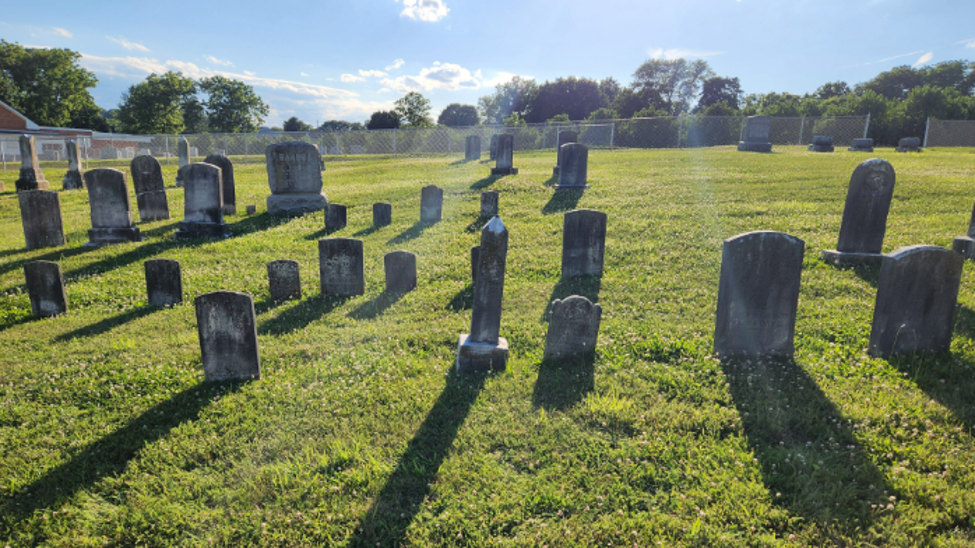
Antietam Church Cemetery, Waynesboro, Franklin, Pennsylvania showing the Harbaugh family burials with spaces for graves missing stones; photo by Lori Samuelson 22 June 2026.

Some discoveries are made by finding something. Others are made by noticing what is missing.

During a recent cemetery-hunting trip through Pennsylvania, Maryland, and Ohio, I visited numerous burial grounds connected to my husband's Harbaugh family and my own Duer ancestors. Some visits led to new discoveries. Others answered long-standing questions.

One stop left me with neither.

Instead, it left me staring at several empty spaces in a family burial plot and wondering whether the answers had been there all along.

For years, I have searched for the final resting places of Elias Harbaugh and his wife, Mary Magdaline Weaver Harbaugh.

Elias presents a challenge because his probate file no longer exists in Franklin County, Pennsylvania. Based on surviving records, he likely died about 1874. Mary appears to have died around March 1877, her death inferred from a deed recorded by her grandson, George Henry, in 1885.

Like many genealogists, I have spent years piecing together fragments of evidence to reconstruct their lives. What I hoped this trip would provide was something more tangible. A tombstone. A burial record. Some confirmation of where they were laid to rest.

For a long time, I have suspected that Elias and Mary were buried in Antietam Church Cemetery in Waynesboro, Franklin County, Pennsylvania.

The theory is not without support. Their only child who remained in Pennsylvania, Frederick Alexander Harbaugh, was buried there in 1894. The cemetery contains several members of Frederick's family, suggesting that the Harbaughs used this churchyard for multiple generations.

Ten years ago, I spoke with the church minister regarding burial records. Unfortunately, the surviving records do not extend back to the 1870s. If documentation once existed identifying Elias and Mary's graves, it has not survived.

Still, I hoped the cemetery itself might provide clues. Cemeteries often tell stories that records cannot.

Families were frequently buried together. Parents, children, spouses, and siblings often occupied adjoining plots. Even when records disappear, burial patterns sometimes survive.

Walking among the Harbaugh stones, I was struck by how weathered many of the markers had become. Time has not been kind to them. Some inscriptions are difficult to read. Others have deteriorated significantly since photographs were taken years ago.

Yet something else caught my attention. Several empty spaces appeared within the family row. Not random gaps. Places that seemed as though stones might once have stood there.

I found myself studying the spaces as carefully as the surviving markers.

Could Elias and Mary have been buried there? Had stones once marked their graves? Were the markers lost to weather, damage, or neglect?

There was no way to know for certain.

My husband, Jim, has an uncanny ability to spot things that others miss. I hoped he might discover a sunken marker, a fragment of stone, or some overlooked clue hidden among the grass.

We searched carefully. Nothing appeared. No broken fragments. No buried marker. No evidence beyond the empty spaces themselves.

We left without answers. Yet I could not stop thinking about what those gaps represented.

Genealogists are trained to focus on evidence we can see and document. We seek records, photographs, inscriptions, and artifacts. We want proof.

But absence can sometimes be evidence, too. An empty place in a family plot may tell a story. A missing probate file may tell a story. A burial record that should exist but doesn't may tell a story.

None of these pieces alone prove that Elias and Mary rest in Antietam Church Cemetery. Together, however, they create a pattern that is difficult for me to ignore. Sometimes all that remains is a possibility.

I left Antietam Church Cemetery without finding Elias and Mary. Perhaps resting quietly among their family members, their identities lost but their presence still remembered.

Genealogy is often portrayed as a series of discoveries and breakthroughs.

In reality, much of our work involves living with uncertainty.

Not every mystery is solved. Not every ancestor leaves a marker. Not every story reaches a neat conclusion.

For now, Elias and Mary remain missing.

But every time I look at the photograph of that family row, my eyes are drawn not to the stones that remain.

They are drawn to the empty spaces and to the possibility that sometimes what is missing can tell us as much as what survives.

Saturday, August 8, 2026

When the Tombstones Disappear


Genealogists spend much of their time searching for things that have been lost.

Missing records. Forgotten stories. Unmarked graves. Destroyed courthouses. Faded photographs.

We become accustomed to loss because loss is woven into the very fabric of family history research. Yet nothing prepared me for returning to a cemetery and discovering that the evidence I had once photographed had disappeared.

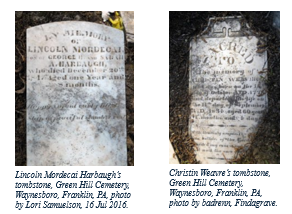
Ten years ago, I visited Green Hill Cemetery in Waynesboro, Pennsylvania, in search of several members of my husband's Harbaugh family.

Their tombstones had not originally stood there.

The family had first been buried in Old Union Cemetery adjacent to a church. In 1923, after the property changed ownership, the graves were disinterred and reinterred at Green Hill Cemetery. According to cemetery staff, efforts had been made to notify descendants through notices published in local newspapers. Whether family members living elsewhere ever learned of the move is unknown.

By the time I visited in 2016, the stones had already endured one relocation.

They were worn; no longer standing they were placed flat on the earth. I photographed each one carefully.

At the time, I viewed the images as routine documentation. Like many genealogists, I had become accustomed to photographing tombstones whenever I encountered them. The task felt important, but not urgent.

After all, the stones had already survived for more than a century. Surely they would remain there for future visitors. Or so I thought.

This summer, while returning from a genealogy conference, I decided to revisit Green Hill Cemetery. I wanted to see the stones again.

Perhaps I would notice details I had overlooked a decade earlier. Perhaps advances in photography would allow me to capture inscriptions more clearly. Perhaps I would simply enjoy reconnecting with ancestors whose stories I had spent years researching.

Instead, I found an absence.

The hillside where the stones had once stood had been altered. The markers were gone. Completely gone. For several moments I simply stared at the space where I expected them to be. Had I remembered the location incorrectly? Had the stones been moved again? Had they been damaged? Had they been placed in storage?

I had no answers.

The cemetery office was closed, leaving me with questions and a growing sense of unease.

What troubled me most was not simply that the stones were missing. It was the realization that physical evidence we often assume will remain forever can disappear without warning.

Genealogists sometimes treat cemeteries as permanent repositories of history. In reality, they are vulnerable places. Weather damages monuments. Trees fall. Floods occur. Maintenance priorities change. Ownership changes. Records are misplaced. Occasionally, markers simply vanish.

The experience reminded me of the countless records I have searched for over the years that no longer exist. Probate files that disappeared from courthouse shelves. Church registers lost to fire. Family Bibles discarded during estate sales. Letters thrown away by descendants who did not recognize their value.

Every generation inherits responsibility for preserving the evidence left behind by those who came before. Sometimes we fulfill that responsibility. Sometimes we fail.

Fortunately, I had photographed the stones during my earlier visit. What once seemed like routine documentation now feels considerably more important.

Those photographs preserve information that may no longer be accessible in the cemetery itself. That realization changed the way I think about every cemetery visit.

Take the photographs.

Record the inscriptions.

Capture the surrounding landscape.

Document the location.

Don't assume someone else already has.

Don't assume the information will still be there next year.

Most importantly, don't assume that stone is permanent simply because it has already survived for generations.

Family history exists in a delicate balance between remembrance and forgetting. As genealogists, we often focus on discovering the past. Perhaps an equally important task is preserving it.

The missing stones at Green Hill Cemetery reminded me that our ancestors' stories are not guaranteed to survive. Their preservation depends upon ordinary people who care enough to record them before they disappear.

Sometimes we search for evidence. Sometimes we become its last caretakers. And sometimes, without realizing it, the photograph we take today may become tomorrow's only surviving record.

3. Building Your Genealogy AI Assistant

  For the past two weeks I’ve been blogging about the importance of personalizing your AI. Last week I wrote how to accomplish that wit...