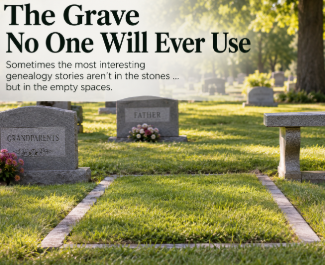
Genealogists spend a lot of time looking for graves. Last month, a cemetery called me about one that isn't there.
My grandparents purchased a family plot where they, my father, and other relatives are buried. One space was intended for my parents.
Then life happened.
My parents divorced. My father remarried. His second wife had other burial plans. The plot remained empty.
Years ago, there was a disagreement about what should happen to that space. I notified the cemetery by certified mail that I wanted it to remain unused and unsold. Then I forgot about it.
Until the cemetery called.
They asked what I planned to do with the plot and suggested that I could be buried there. No, thank you.
Then came a much more interesting idea. Why not put a memorial bench on the unused space? Visitors could use it, and my husband and I could have our names and dates engraved on it.
I loved the concept. Until I got the price. Nearly $15,000. Suddenly I loved grass.
A less expensive option brought the cost down to about $4,300 for the bench, engraving, foundation, and cemetery fee. I still loved grass.
We considered another possibility. What if we gave the space back to the cemetery for an unengraved bench everyone could use?
My husband immediately spotted the problem. What would prevent the cemetery from someday removing the bench and selling the burial space to someone else? Since the cemetery is running out of available space, that wasn't an unreasonable question.
So, for now, the grave will remain empty. And that got me thinking.
Genealogists study what is present in cemeteries, stones, inscriptions, symbols, dates, and family groupings. Perhaps we should pay more attention to what isn't there.
An empty grave can be evidence.
My grandparents bought that space because they expected their son and daughter-in-law to be buried near them. Divorce, remarriage, and changing burial preferences created a different future.
The empty space documents both stories; the future my grandparents planned and the one that actually happened.
So when you're walking through a cemetery, look at the gaps between the stones, too. If there's an unexplained space in a family plot, check the cemetery records. Find out who purchased it and who was supposed to be there.
The person who isn't buried there may have quite a story.
As for our family plot, I've decided it doesn't need a body, a monument, or a $4,300 bench to justify its existence.
The empty space tells the story.
And the grass is free.


No comments:
Post a Comment