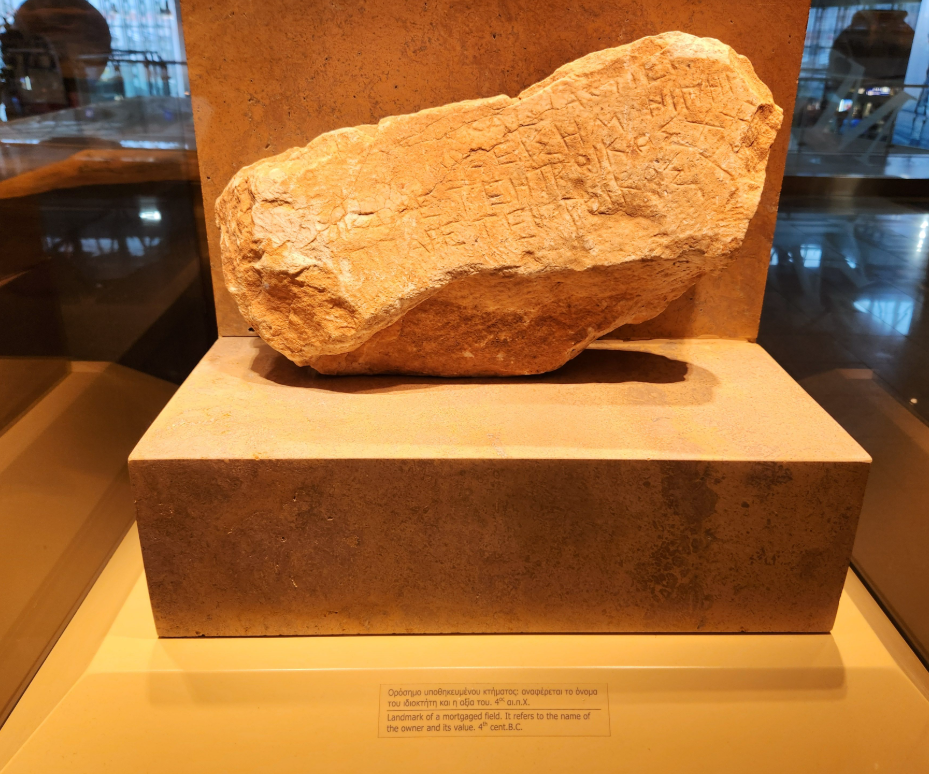
I didn’t expect to find a mortgage record at the Athens, Greece Airport Museum.
But there it was, carved in stone.
Not a scroll. Not a document tucked into an archive. Not something filed away in a courthouse.
A rock. Sitting out in the open for the world to see.
The ancient Greeks called these markers horoi, boundary stones that recorded debt. They were placed directly on the land itself, announcing that the property had been pledged as collateral. The inscription would typically include the name of the owner and the value of the obligation.
In other words, this wasn’t just a marker. It was a public declaration: “This land is mortgaged.”
Now imagine that for a moment.
Imagine your mortgage, not buried in paperwork or hidden behind passwords but carved into a stone and planted in your front yard.
No privacy.
No discretion.
No quiet understanding between borrower and lender.
Everyone who passed by would know. Your neighbors. Strangers. Anyone walking down the road. Your financial situation on display. And we so get up tight about privacy today!
As a genealogist, I didn’t just see a stone. I saw a record. A remarkably rich one.
Here, in a single object, was evidence of:
- Property ownership
- Economic status
- A named individual tied to a specific place
- Participation in a financial system that feels surprisingly familiar
This was, quite literally, a land record and a lien combined, preserved not in ink, but in stone.
And then, of course, my mind went where it always goes. I found myself wondering…
Could one of these have held my family’s name?
It’s a long stretch, I know. My own lines don’t trace back to ancient Greece through paperwork but through maternal DNA. But that thought, that somewhere, someone’s ancestor is named on one of these stones, stopped me.
Because for that family, this isn’t just an artifact. It’s a record.
A tangible, physical link to a moment in time when land was pledged, risk was taken, and a name was important enough to be carved for all to see.
We often think of the past as distant, disconnected from our modern lives. But standing there, looking at that stone, I realized just how familiar it all felt.
People borrowed money.
They leveraged what they owned.
They took risks.
They worried about outcomes.
The tools have changed.
The systems have evolved.
But the human story?
Not so much.
Today, our mortgages live in digital files and legal documents. They’re processed quietly, stored securely, and largely invisible to the outside world.
In ancient Greece, they were anything but invisible. They were meant to be seen. There’s something striking about that difference.
Not just the lack of privacy but the permanence. Paper can be lost. Files can be deleted. Systems can change.
But stone? Stone remains.
As someone who spends her time digging through land records and probate files, I never expected to encounter a mortgage like this, one that didn’t require deciphering handwriting or chasing down courthouse copies.
It was simply there to be translated. Clear. Direct. Enduring.
Long before courthouses and filing cabinets, before clerks and digital databases, people marked their obligations in the most permanent way they knew how. They carved them into stone.
And standing there, I realized the past isn’t as distant as we think.
It’s just written differently.



No comments:
Post a Comment