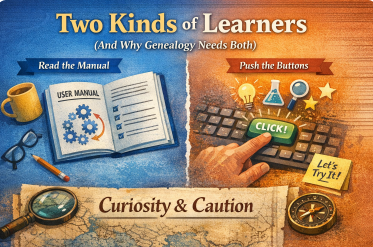
Someone recently observed that there are two kinds of people in the world:
Those who learn by reading the manual.
And those who learn by pushing buttons.
My husband calls me “click-happy.” He means it affectionately and accurately. When I’m faced with new technology, my instinct is to explore. To try things. To see what happens. That’s how I learn.
Some people learn top-down. They want the framework first. The theory. The rules. They read, then they act.
Others learn bottom-up. They learn by doing. By experimenting. By poking at the edges and seeing what’s possible, then building understanding from experience.
And over the years, I’ve realized something important: neither of these approaches is wrong.
Most of us are actually a mix of both, depending on the tool and the stakes.
But in genealogy? Let’s be honest. Very few of us learned Ancestry, FamilySearch, DNA tools, or mapping tools by sitting down with a 300-page manual first. We learned by searching. Clicking. Trying. Backing up. Trying again.
And when I look back at some of the most important breakthroughs in my own research: Croatia, the Palatine migrations, strange boundary changes, unexpected court records, whole clusters of “this can’t be right… oh wait, it is” moments, not a single one of them began with a manual.
They began with curiosity.
With clicking.
With trying something that wasn’t in the plan.
The manual tells you how a tool is supposed to work. Exploration shows you what it’s actually good for.
Here’s the part that really matters, though: the real risk in genealogy (and in tech generally) isn’t clicking. It’s not having good habits.
What actually protects your work is not fear. It’s practice:
- Working on copies, not originals
- Having backups (and backups of backups)
- Using version history and undo (Ctrl+Z) after analyzing and discovering your first find wasn't accurate
- Not trusting any single tool, human or machine, blindly
Fear doesn’t protect data. Habits do.
We already live in a world where far more damage is done by accidental deletes, bad syncing, overwritten files, and simple human error than by any new tool. AI doesn’t change that reality, it just joins the long list of tools we learn to use wisely.
And in a field like genealogy, which is built on exploration, pattern-spotting, and following trails that might go nowhere, curiosity isn’t a flaw. It’s a requirement.
Archives don’t come with manuals.
Families don’t come with instructions.
Records don’t announce what they’re going to reveal.
You find things by trying paths that might not work.
So yes, some people will always prefer to read first and click later. Others will click first and read later. Both approaches have value. But let’s not confuse curiosity with recklessness, or caution with wisdom.
We don’t need fewer curious genealogists.
We need more curious genealogists with good habits.
Because almost every real discovery starts the same way:
“Huh. I wonder what happens if I click this.”



I have to admit I'm a reader first, and try later. When I first got into genealogy 30 years ago, I began by reading The Source from cover to cover. I didn't understand or remember everything, but it gave me the idea of what is out there. This was also before genealogy on the Internet, so there were no places to click yet.
ReplyDelete