Genealogy is expensive! There's costs for membership to associations and online databases, travel, research supplies, vital records, mailing, and conferences. When doing our taxes earlier this year the reality of the expenses hit me. When I received an email recently from a reader who mentioned how the costs were pinching her lifestyle I decided to investigate ways to save.
I'm open to suggestions so please readers, comments are welcome on ways you've found to be frugal! The focus today is on association dues because one of the benefits of belonging to a group is discounts on related items.
Most likely your local and state association's yearly membership dues are reasonable. I believe it's important to support your local group, if you can afford to do so. My local group costs $17.00 annually and provides a weekly email of free classes offered and genealogy tips. If the cost is prohibitive for you, speak with the group about ways you can take part without paying dues. Volunteering at events, assisting with the newsletter or transcribing local records may all be needed and appreciated more than the amount of the annual dues. It can't hurt to ask!
My state society costs $25.00 per year. I have access to a monthly free webinar, archived journal and newsletters, and access to a members only forum where I can post questions or ask for help with lookups. There are also occasionally special offers; the current being Fold3 for half price ($49.95). Adding the cost to join the state society with the Fold3 discounted membership is less than the cost for Fold3's regular price, however, Fold3 offers discount premium memberships all the time so that alone would not be a reason to join the state association. For me, the webinars and journal are well worth the price of $25.00.
Regional societies offer specialization and if you're looking to cut costs this may be where to do it. For example, I do a lot of research in the midwest, mostly Indiana-Ohio-Illinois. There are many local societies and historical groups in the areas that I mine for records, along with larger groups, such as the Ohio Genealogical Society, which costs $35.00 a year. I tend to not join these groups because I don't live close enough to benefit from the local events they offer. Before you join, check out the groups website and contact members for their advice on where to find what you're looking for. I have found the majority are knowledgeable and willing to share their expertise. If there is a record you need that is in their holding, discuss the cost involved for you to receive a copy. I try to pay it forward by also sending them the information that I have collected at the end of my project. This allows their resources to grow and benefits the whole group. If you find that the society won't assist you unless you become a member, contact the local library instead by emailing through the Ask-a-librarian link. For a quick look up, direction in which to research, or knowledge of where a record may be housed these folks are the best and it's free!
If you research in primarily the New York or New England area you may want to join the New England Historic and Genealogical Society (NEHGS) and the New York Genealogical and Biographical Society (NYG&B). NEGHS is $89.95 annually; I love their quarterly magazine, journal (The Register), weekly e-newsletter and using their library for free. I find their AmericanAncestor.org database powerful, too. I've attended two of their workshops in the past six months (one in Boston and one in Florida) and weren't all that impressed, though. They also have an Ask-a-genealogist service that's free but I've never used it so I can't attest to how it works. I have asked for help in person and found some of the genealogists to be extremely helpful. I'm trying to limit my book collection so I haven't taken advantage of the 10% discount on what they publish. If you're going to save check your local public library. Mine has access to the database and the journals so I really don't need to pay for this membership but having the resources at home is worth it for me.
NYG&B is $70.00 per year and offers a quarterly journal (The Register) and review of genealogy news (The New York Researcher), monthly e-newsletter, free FindMyPast US-Canada subscription, access to records in special collections, and discounts on other promotions. My library does not have copies of The Register but another library in my area does. If my budget needed to shrink, I'd cut this and read the superb journal in the library.
National societies have many benefits of membership. The National Genealogical Society (NGS) is a bargain at $65.00 a year. Members receive access to free online courses, a quarterly journal, (NGS Quarterly) and magazine (NGS Magazine), digital monthly newsletter, and access to Bible records, ancestry charts sent in by members, and a marriage and death notice database from early American newspapers. They also offer some partnership discounts. There are additional fees to attend conferences, however, members receive a discount. I, personally, would not cut out belonging to this group.
I realize the hobbyist is not going to join the Association of Professional Genealogists as a professional member for $100.00 a year. A subscriber only member price is available for $45.00 annually and provides a paper copy of the Quarterly journal. If you're a professional, though, this organization is well worth the cost; the members only listserv alone is an extremely valuable resource, along with professional development webinars, conferences and discounts, such as a 25% off a JSTOR pass, 10% off Legacy Family Tree software and webinars, $20.00 for Rootsmagic and book, and 10% off BYU online certificate in genealogy program tuition. There's more deals then I listed but subcribers only do not have access to them. So unless you're going pro, you won't have a cost savings here.
The Board for Certification of Genealogist (BCG) has a free website that is of value to everyone interested in genealogy, whether you want to become certified or not. The free Springboard blog is informative regarding methodology, links are given to educational programs so you can continue to grow and the skillbuilding and sample work sample areas are important for all levels of genealogists. Most importantly, The Standards are a must and only $6.99 for a Kindle edition.
Notice I haven't mentioned lineage society memberships? That's because the application fees and membership dues vary. With all the added costs, such as luncheons, travel to events, and highly encouraged donations for philanthropy, if you're on a budget it's best to avoid them. Their members may volunteer to help newbies though, so you might want to check that out. Some groups, like the Daughters of the American Revolution have very helpful information for free online to everyone.
Here's the rounded cost if you've joined all - $407.00. On a fixed income, my recommendations are paying for your state and NGS membership and definitely purchasing a copy of The Standards if you don't have one already - that cost is less than $100.00 a year.
Next time we'll explore cutting costs for online databases.
Sunday, May 29, 2016

Wednesday, May 25, 2016
"Every Genealogy Record You Need is Online" - I Beg to Differ!
I
want to apologize in advance for this long blog. Possibly, this should be two or three but due
to the importance I don’t want to break it up.
Recently,
I've heard and read in a number of places that there has been so many additions
of records online that there is no reason to search elsewhere. I
vehemently disagree!
I
wasn't going to blog about this topic because I am so adamant that the
statement is wrong I don't even want it out there as a meme but I changed my
mind due to the frequency this belief has been expressed lately. Here's where
that information popped up just in the past two weeks:
- A listserv to which I
belong
- Two emails I received
from hobbyists
- The 18 May 2016 Legacy
Family Tree Webinar by James M. Beidler
- A volunteer genealogist
at my local Family History Center
My own experience has
shown me that there is nowhere near enough online "that many genealogy
scenarios could be taken care of from start to finish using just online
sources." I will agree that there is A LOT of records that are of
value to genealogists that have been uploaded from a variety of sources since the
beginning days of the internet. I will also agree that someone COULD
build a tree with just online sources. I know that practice is happening
frequently but that doesn't make it right. In fact, I believe it's
not advisable to do that for many reasons.
Before I discuss the
reasons to venture offline in your search, I want to identify why there's this
mistaken belief. I've come up with the following:
- Time - we live in a fast paced world and with all the
day to day pressures we face to earn an income it is often not easy for us
to visit an archive to check out documents that may or may not be
available. (One of the comments on the listserv was that it was a
waste of time to look for an unknown record.)
- Money - genealogy can get expensive and frugal
genealogists don't always have funds available to fly off in search of a
record. (One of the emails I received mentioned a fixed income
limiting travel. That is a valid reality so I'll be blogging soon about
ways to maximize your income source so you can pursue genealogy.)
- Advertisements - simply perform a search for
"genealogy records" and you'll receive 36,000,000 hits.
The first one that appears advertises a company that boasts
"6.1 billion records & newspapers. Powerful search technology
- Start 2 billion profiles - Over 6.3 Billion records - 31 million
family trees." No, that wasn't even for Ancestry or
Familysearch. Those large figures give the impression that there is
everything in one place so you won't need to look elsewhere. Don't fall for it!
- Ease of Access - why go in search of the unknown if
you've got a known at your fingertips? Plus, "millions"
have already posted your family tree online which you can view and copy.
Putting that all together the
thought process becomes that those billions of records are right there in front
of you just waiting for your click! You've spent quite a bit of cash on
membership so you want to get your money's worth, which is understandable.
Why reinvent the wheel, just copy from someone else's posted family tree
and voila, you're a genealogist. From my experience that is far from
reality and I know others have had similar situations that back up my claim.
Please be aware that I
value online genealogy sources and highly recommend them as a starting point. Occasionally, if a client limits my time, I may have to just perform an
online search. I clearly note, though, in the report that further hours
need to be spent performing a boots on the ground search. You can’t be reasonably exhaustive unless
you’ve done so.
I do look at unsourced trees online. "Look" is the key word in the previous sentence! Once I look I think about the validity and if it's plausible, I'll add it to my research plan to search for records. Records is plural - I don't rely on just one source.
I do look at unsourced trees online. "Look" is the key word in the previous sentence! Once I look I think about the validity and if it's plausible, I'll add it to my research plan to search for records. Records is plural - I don't rely on just one source.
For my Kinship
Determination Project (KDP) portfolio submission for certification through the
Board for Certification of Genealogists, I selected a family I am not related
to but had much data previously found while researching online. I started
out by printing all of the documents and assembled them in folders by
generations.
When I began to
analyze the info I noticed in the second generation's wife's obituary that she
had been a member of a particular church for many years. Huh? I had
her online baptism record from a different denomination, marriage record (handed
down through the family) not specifying a denomination and she was buried
(online sources) in the same denomination as where she was baptized. Did I
have a mix up in identity? Her maiden name was common but her married
name was not. So I got the cemetery record (NOT ONLINE) and then
investigated the cemetery; it contained many different denominations and it was
where her parents were interred. That made sense. I next decided to
contact the church mentioned in the obituary where she had been a long time
parishioner for any records. It took me months to get a response.
Finally, I was told by the acting minister that a former parishioner might know where the old records
were housed. Contacted her and she didn't but she had saved on CD old
church newsletters from the 1990's which contained transcriptions of a diary
(NOT ONLINE) that had been donated to the church about the beginning days of
the denomination in that area. It turns out that the diary writer lived
across the road from the family I was writing about and was related by
marriage. The writer mentions the family numerous times throughout and I
was able to locate deeds and estate paperwork (NOT ONLINE) that was somehow
omitted in the county's online index. I also better understood why the
family relocated to the area. Making an
analysis from simply looking at online sources would have given me the wrong
reason for the move. Additionally, all the online sources had a child
that died at birth but the diary had recorded specific information as to the
cause of the child's death three months after birth. The cemetery record
only listed the year of birth and death so it appears online sources assumed
the child had died at birth by just looking at the tombstone picture posted but that wasn't the case. The numerous online
trees are wrong because no one looked for a record that wasn’t digitized.
Nondigitized records
enabled me to discover church records in another state that identified previous
generations. Those records are NOT ONLINE. I was also able to find
pictures of one of the individuals from a church's commemorative book that was NOT
ONLINE. This led me to find more pictures at a local library that also were
NOT ONLINE.
The biggest find,
though, was for a related line in a prior generation. The
author mentioned her sibling. NO ONLINE source ever connected the author
(who was not in my tree) to her sister (who was in my tree). The
individual who had children died before mandatory state record requirements so there was no death record that named parents or place of birth..
The NOT ONLINE cemetery record had a maiden last name but not place of birth.
I obtained the diary writer's death certificate and the maiden names did
match, a place of birth was noted and it was not in a state I had searched for
the sister's record. After I submit my portfolio, I will happily begin
researching that line in a different state.
I understand how this
happened. Individual 1 had no children
so no one ever bothered to obtain her NOT ONLINE death certificate. Individual 2 had children but no death
certificate. Lots of trees online for both
but no one had ever checked for nondigitized records of Family-Associates-Neighbors.
It is true that the nondigitized information
was not quickly accessible. I did invest a
lot of time and a little money, about $8.00 for the death certificate, but the
effort was well worth it. It enabled me
to correct wrong online information, connect branches and gain a better
understanding of the family dynamics.
What I overheard at my
local Family History Center a few days ago made my blood boil and was the last straw for me
regarding this topic! A newbie couple
had come in for help as they had found numerous online trees that connected them to a
turn of the 20th century gateway ancestor. Believing the unsourced trees were accurate,
they booked a flight and headed off across the pond to visit the ancestral
home, a small village in the
Mediterranean. Although they do not speak the mother tongue they met a family
with the same surname who shared documents that took the family back
centuries. The problem was that those
documents did not match birth and emigration records they found online when they returned from their trip. I could spend another blog going over all
that is wrong here but for time sake, I’m just going to mention the comment made
by the volunteer genealogist – something to the effect that the online unsourced
birth date must be accurate because it had a day, month and year. Huh?! Finally,
another volunteer recommended that the newbies contact the posters and ask
where the date came from. Not surprisingly,
they had and no one responded. None of the volunteers offered to the newbies
that perhaps the same surname people they had met and the online posters were
not of their line nor that people post wrong information all the time.
What I wanted to hear
was “Take that birth info out of your tree until you can prove it.” Or how about making recommendations to
newbies about where they can find additional information, like church records, emigration,
naturalization, census, land, probate, etc. and show them how to analyse what they discovered. If that was too overwhelming then refer them to someone who will do the
research accurately. Perpetuating the myth that online data is correct is wrong!
Will we ever reach a point where one can comfortably say all you need for research is online? I doubt it. How could one know what remains out their in the future to find? No one knows what is hidden in a box in someone's attic, has been donated but not cataloged in a
repository hundreds of miles away by a descendant who left the area or for sale
in an antique store somewhere.
Mining every reasonable location for
existing records by following the breadcrumb trail to people and places is critical and always will be necessary. The reward is worth it.
Sunday, May 22, 2016
An Update on Submitting the BCG Portfolio
I’m finishing up with my portfolio for submission to the Board for Certification of Genealogists and
I have butterflies in my stomach! Officially,
I have until late October but since I selected several papers that I had
previously done for clients last fall and winter, I am about finished.
At the National Genealogical Conference in Ft. Lauderdale, I was able to view successful portfolios that were submitted. I also found it useful to be able to pick the
brains of some of the Certified Genealogists (CGs) that attended the "On the Clock" dinner. So glad I was able to attend and meet several
other “On the Clockers” and those on the other side.
Additionally, the National Genealogical Society conference
enabled me to further refine my skills and now I pulled out the Kinship Determination Paper I
finished last month and reread it yesterday. I caught one missing comma and changed one sentence. I'm satisfied with the content and the numbering so I just need to take another look at my footnotes. I had bolded a few that I knew weren’t quite
right as I was so into the writing I didn’t want to stop and lose the momentum.
I also need to make sure I’ve been
consistent with my citations. The next few weeks I'm busy with other tasks so I probably won't revisit it until mid-June.
I’m still uncertain
if I should hold off portfolio submission until after an upcoming trip to DC
this summer or not. On the one hand, I
want to submit before I get extremely busy with my full time job in late
July. On the other hand, I have this
nagging feeling that the missing record in Pennsylvania will miraculously show
up if I look one more time. The document
was supposedly misfiled in the 1960’s and hasn’t been found since. Why in the world I think if I look again I’ll
find it now I don’t know! I’ve already
looked twice over the past 5 years AND hired someone to try to find it. Clearly the “3rd time’s the charm!”
as my mom used to say didn’t happen and a fourth visit would be beyond
reasonably exhaustive. My thought process is bordering on irrational
and I realize that. This certainly is like the tongue in cheek meaning of insanity - doing the same thing over and over expecting a different result!
Reflecting on my behavior I see this as déjà vu – I did the
same thing when I was ready to submit my portfolio to the National Board of Certified Teachers
several years ago. One morning I woke up
and I knew that there was no more I could do so I just packed it all up and
mailed it off. Even so, I stood in
Office Depot and just stared at the box.
The clerk was nice, though I’m sure she thought I was nuts. She told me to take as long as I wanted. As soon as she said that, I was able to let it
go.
Now I have to decide if I’m going to send it snail mail or
electronically. Decisions,
decisions! Another way to procrastinate
finality! Will keep you informed...
Wednesday, May 18, 2016
A FREE Research Assistant - Google Keep
Found a new tool that could help you immensely with your research notes, to do lists, and anything else you want to write and remember. From Google, it's entitled Keep and with just one click, you can save your work and be able to retrieve it from any online device.
Click on the left hand corner of the Keep page where there are three horizontal lines (the main menu bars). This will open up the main menu where you can view your notes and reminders, once you create them. Filing is easy, just click the "Create New Label."
If you'd like to share what you created, click on "Settings" and make sure "Enable Sharing" is checked.
You access Keep through your Google account so if you have gmail or Google+ you already have a Google account. If you don't have an account, the page should direct you to how to obtain one but I haven't checked that out since I have an existing account.
Keep works on both IOS and Android so whatever is your preference, you can use this tool. It does need Chrome so if you aren't using that already, you may have to download it for Keep to work efficiently. The Chrome download is supposed to also be available from the Keep page but again, I have it so I'm not able to verify that information.
So, how can you use this with your genealogy? What I think is the best feature is that it is a blend of Evernote and Pinterest. I can click the grey lightbulb on the panel to add text or a part of a webpage. I especially like that I am able to simultaneously update my research log that I'll display on Keep; the display is viewable like Pinterest. Another beneficial feature is that I can see everything on the same page at once which will make sorting for a timeline or rearranging when analyzing the records much easier.
I can then create a label for the whole group which will enable me to separate out various projects that I'm working on simultaneously. This method also allows me to quickly access the information anywhere (desktop, laptop, tablet, phone) AND be able to retrieve everything about the project in an organized way. Want to see all your labels? Simply click the main menu bars and it will list all the labels you have previously created.
The "Reminders" feature will also help you stay organized. Give it a try!
Click on the left hand corner of the Keep page where there are three horizontal lines (the main menu bars). This will open up the main menu where you can view your notes and reminders, once you create them. Filing is easy, just click the "Create New Label."
If you'd like to share what you created, click on "Settings" and make sure "Enable Sharing" is checked.
You access Keep through your Google account so if you have gmail or Google+ you already have a Google account. If you don't have an account, the page should direct you to how to obtain one but I haven't checked that out since I have an existing account.
Keep works on both IOS and Android so whatever is your preference, you can use this tool. It does need Chrome so if you aren't using that already, you may have to download it for Keep to work efficiently. The Chrome download is supposed to also be available from the Keep page but again, I have it so I'm not able to verify that information.
So, how can you use this with your genealogy? What I think is the best feature is that it is a blend of Evernote and Pinterest. I can click the grey lightbulb on the panel to add text or a part of a webpage. I especially like that I am able to simultaneously update my research log that I'll display on Keep; the display is viewable like Pinterest. Another beneficial feature is that I can see everything on the same page at once which will make sorting for a timeline or rearranging when analyzing the records much easier.
I can then create a label for the whole group which will enable me to separate out various projects that I'm working on simultaneously. This method also allows me to quickly access the information anywhere (desktop, laptop, tablet, phone) AND be able to retrieve everything about the project in an organized way. Want to see all your labels? Simply click the main menu bars and it will list all the labels you have previously created.
The "Reminders" feature will also help you stay organized. Give it a try!
Sunday, May 15, 2016
Top Five Conference Lessons Learned
Finally cleaned up the tote bag with all the info I accumulated at the National Genealogical Society Conference held the first week in May in Ft. Lauderdale. I learned a lot but these five ideas keep circulating around in my head:
- Mind Maps - I always encourage my students to use them but I'm negligent in doing so myself. Elizabeth Shown Mills displayed quite an elaborate spider web map that showed relationships and it was impressive. I'm adding this to my "to-do" list to incorporate in my practice.
- Identify Expertise - D. Joshua Taylor mentioned that he always asks antique store owners what their area of expertise is. Although I chat with store owners it never dawned on me to ask for specific information. He related a wonderful story about finding a relative's belongings in a shop in New York state by simply asking that question. Definitely will add this to my genealogical tool box!
- WorldCat.org - One of the most valuable online resources to find materials I somehow missed the box on the right side that's called "Related Searches." You have to sign in to view which I often don't do. This may give you information that you didn't even know existed! Definitely worth a look.
- DNA - I need to really get serious about DNA testing! I learned a bunch from Tom Jones' lecture but there is still so much more I need to learn. That is where I'm going to be focusing my continuing education.
- At the BCG Luncheon, I learned a lot about copywrite and fair use. Didn't know that there is a free Fair Use Evaluator online that can help you determine whether a work is fair use or not.
I learned so much more but these items were those that I starred as Ah-ha moments and I wanted to share. Enjoy!
Wednesday, May 11, 2016
Heirlooms and Hand Me Downs – Who Cares?!
I read recently an
online article about the glazed over look that family members often get when we
genealogists start talking about the past. The author mentioned that he
was frustrated that his family doesn’t seem to care while the actors featured
on tv shows are always so excited about their genealogy finds.
I understand why our
family members often don’t get it. Here’s my top 5 reasons for the
disconnect and a way to get around it:
1, The past is done and it’s not
relevant to me. Geez, I even had that philosophy when I was young.
Think about the 1960’s mantra of not trusting anyone over 30! It’s rare
that young people can connect the dots of how several times great grandpa’s
life could be meaningful today. It's not just young folks. Some people
never out grow this belief so don’t get me wrong and think this view only
applies to youth. The solution is simple – tell or write engaging family
stories that are applicable to life today. Write the story as a cliffhanger
and I bet your
relatives will want to learn more about their past.
·
2. Concrete tactile learners – there
are many learners that have to SEE the picture, TOUCH the artifact, or LISTEN
to the voice in order to process the information so show that photo taken at
the 1920 family reunion and point out the resemblance to Great Uncle Fred.
Caution is needed, though. Don't overload them with a lot of photos
or items as they'll disconnect from sensory overload. A little goes a long way and what you're aiming for is to pique interest.
·
3. Money,
Money, Money! Of course the television actors are excited about their
family history finds. Your relatives would be, too, if they were being
paid for appearing on tv. This is not a suggestion to pay our family
members to listen to us but it does explain why there may be a lack of
enthusiasm. D. Joshua Taylor, of Ancestry Roadshow, mentioned at the National
Genealogical Society Conference that his grandma updated the family history
annually and every one expected to receive a copy gift wrapped under the
Christmas tree each year. That tradition, coupled with the $20. bills she
hid in the pages, did help family members look forward to the gift. (And he's
interested in the family genealogy so clearly this approach worked. Thank
you, Josh's Grandma!)
· 4. Individual
Attention. Another reason tv actors are enthusiastic is because they are
exclusively meeting one on one with noted researchers who sweetly answer their
every question and have the documents all nicely transcribed for them. I
tend to talk family genealogy when everyone is together and that may be counter
intuitive. Instead, mention some tidbit that can easily blend in with the
conversation when you are with only one of your family members. A few
weeks ago, while cleaning out a closet, I wondered what happened to a
collection of needles I once had - darning, knitting, embroidery, tapestry,
etc. that originally belonged to various females in my lines. When I was
into arts and crafts, I used them and always thought about the original owners.
Daughter said, "Oh, I have those." She brought them over on
Mother's Day and I pulled out a few and said, "I remember when your great
grandma used these to embroider a kitchen towel" and "Grandma Duck
used to use these when she repaired the hallway stairs carpet, the one I told
you about that I used to slide down on my derriere when I was five."
Will daughter remember and cherish? I don't know but I gave it my
best shot! She is quite artistic so I suspect she will make the connection and remember it.
· 5. Road trip needed! When you think of "Who
Do You Think You Are?" or "Long Lost Family" you know the
participants get to travel. Most family members would just love it if
they got to go somewhere, all expenses paid. I always sneak in a side
trip whenever we used to vacation and my family still talks about the house on
Long Island that several times great grandpa John Hicks Williams had built that
just happened to be for sale so we got to see the inside (online - couldn't
find an agent who was available to give us a tour). Walking in your
ancestor's foot steps is a powerful experience and with summer coming, perhaps
you can take the most interested of the family on an excursion.
Hope these suggestions help get your family interested in your findings - Happy Hunting!
Sunday, May 8, 2016
Life is Short, Do it Now!
Just
back from the National Genealogical Society conference in Ft. Lauderdale and it
was awesome. Wonderful to meet
face-to-face with folks I have only interacted with online and some I haven’t
seen in person in awhile.
The
only downer was that a colleague of mine from my primary job had to cancel at
the last minute due to a family emergency.
She is working towards a PhD in creative writing and was looking forward
to attending the writing workshops that were offered. Additionally, she is interested in family
history and is the keeper of her family’s records so the conference was a great
fit for her.
As
genealogists, we typically place our family’s first so her disappointment in
missing the conference was minimized by her right on priorities. This got me thinking of the lost
opportunities that we often miss with our own family members. Wouldn’t it be wonderful to just have one
hour with that brick wall ancestor (and maybe a translator included!)? Don’t you wish you could ask dearly departed Great
Aunt Alice a couple of questions? Recording
her answers would be icing on the cake.
Do
yourself and the generations to come a favor and ASK TODAY your mom, grandma,
and if you’re really lucky, great grandma, what you’re dying to know. Make sure you write it down (and seriously, cite
it). It’ll be a Mother’s Day gift that
will be appreciated long into the future.
Enjoy your day!
Subscribe to:
Posts (Atom)
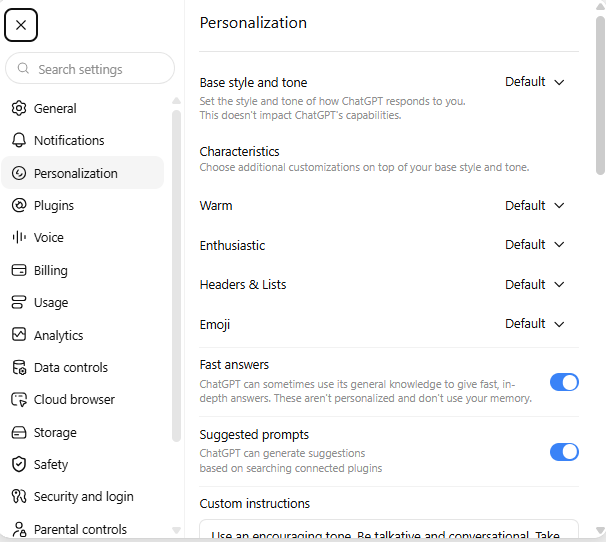
2. Customizing ChatGPT: The Five Minutes That Will Save You Hours
In my last article, I explained why every genealogist should customize their artificial intelligence assistant before asking it to he...
-
AI Image If you build enough family trees, you start to notice patterns that don’t show up in history textbooks. Clusters of deaths. ...
-
How a quiet English lineage turned into a political scandal and what it taught me about truth, technology, and trust. AI Image I use AI al...
-
Available at Genealogical.com Today’s blog is a book review of Ultimate Guide to Mastering FamilySearch by Dana Ann Palmer. Long-tim...


