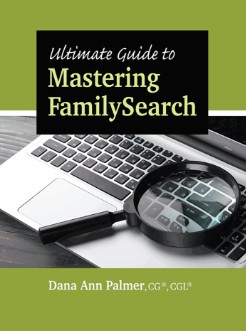
Today’s blog is a book review of Ultimate Guide to Mastering FamilySearch by Dana Ann Palmer. Long-time readers won’t be surprised to learn how this review came about; it was a classic Lorism moment.
Shortly before Christmas, during a snowstorm, my husband braved the walk to the mailbox while I stayed inside working on a client report. “You got a package,” he called. I wasn’t expecting anything; our Christmas gifts were already wrapped and stacked in a box waiting to be transported to one of our adult children’s homes on Christmas Eve. Curious, I abandoned my computer to investigate.
The return address was Genealogical Publishing Company, but I couldn’t recall ordering anything. Inside was Ultimate Guide to Mastering FamilySearch, along with a packing slip clearly intended for someone else. Confused, I emailed the publisher and received a quick reply: I could keep the book, and they’d look into the mix-up. After a couple of emails back and forth, I agreed to write a blog post about it.
Apparently, the universe really wanted me to have this book and you might want one, too.
This is a hefty volume and very much a “start here” guide for those who want to use FamilySearch.org but aren’t, as my husband affectionately calls me, “click-happy.” By that, he means fearless and impatient: I will boldly click my way through a new website without hesitation. If FamilySearch feels overwhelming or intimidating, this book is clearly designed for you.
It’s also well-suited for people who aren’t particularly comfortable with computers. The book is packed with screenshots showing exactly what the pages look like, so readers can follow along visually and reassure themselves they’re in the right place.
That visual-heavy approach did raise one concern, which I shared with the publisher: websites change. A lot. Screenshots age quickly, and I worried the book could become obsolete. I was told that updates would be posted on the publisher’s website if FamilySearch undergoes major changes. Problem solved.
If you’re a beginner but not much of a reader, no worries. Although the book runs 225 pages, most of that is screenshots, arrows, and visual cues. The actual text is limited. Follow the red arrows and you’ll be just fine.
My advice for everyone, regardless of experience level, is to start with the summary on page 222. It’s one of the strongest sections of the book and provides a solid overview. The Table of Contents and Index are also genuinely useful, especially for intermediate users who already know the basics and want to jump directly to specific tools.
I was surprised to see that the book includes information on CETs (Community Owned Trees), which are user-created trees donated to FamilySearch via GEDCOM. These are not the same as the global Family Tree that all users can edit. What isn’t stated and really should be is the usual caveat: like all online trees, errors happen. Beginners especially need to remember that information being recorded does not make it correct.
That said, CETs are typically created and donated by professional genealogists. Are they perfect? No. But they are far more likely to be compiled using the Genealogical Proof Standard and to be fully sourced. I plan to donate my own tree someday, assuming I ever finish my Great Britain research (sigh).
I was equally pleased to see extensive coverage of one of my favorite FamilySearch tools: the FamilySearch Wiki. This is an outstanding resource, particularly when used alongside a traditional search engine and AI tools. The Wiki is often the fastest way to determine what records exist, where they’re held, and what gaps remain. Not everything has been digitized, and the Wiki helps keep expectations realistic.
It’s important to remember that the Wiki is static, it changes only when FamilySearch employees update it. My recommendation is to start there, then move on to dynamic tools like search engines and AI to see what else might be available.
For intermediate users and above, the searching tricks in Chapter 3 are especially useful. We can all use a reminder to use Boolean searching effectively. The book also walks readers through FamilySearch’s AI-powered Full-Text Search tool. If you haven’t had success with it yet, the step-by-step instructions here are worth following. Full-Text Search, combined with DNA results, has helped me solve several brick walls in just the past year.
I was also glad to see a section devoted to Images, which was my favorite FamilySearch feature long before Full-Text Search existed and one I still rely on heavily. One thing I’d add, though, is a warning for beginners: microfilm collections can be confusing. To avoid waste, records from one locality may be followed immediately by entirely different record types from another place halfway around the world. It’s efficient, but it can definitely throw off someone new to the platform.
My only real suggestion for improvement is that the book should begin with a clear, step-by-step explanation of how to create a FamilySearch account. It isn’t difficult, but for users who don’t spend much time online, even that first step can be intimidating.
Ultimate Guide to Mastering FamilySearch does exactly what it promises: it walks beginners, patiently and visually, through a platform that can otherwise feel overwhelming. Its strength lies in its screenshots, structured guidance, and clear explanations of core tools, especially the Wiki, Full-Text Search, and Images.
If you’re new to FamilySearch, not especially tech-savvy, and prefer learning by seeing rather than reading, this book will likely feel reassuring and approachable. More experienced researchers may find it useful as a reference or refresher, though not groundbreaking.
In short: this is a visual instruction manual, not a methodology guide. Used wisely, it can help users get oriented and move in the right direction. Used uncritically, it risks reinforcing the idea that genealogy is about following arrows rather than evaluating evidence. As always, the tool is only as good as the researcher using it.
Available in both ebook and print through Genealogical.com.


Very good assessment of the strengths and weaknesses of this book, which I reviewed last month. While I especially appreciated the color screen captures for step-by-step instruction, your point is well taken that websites change all the time. I'm glad you asked the publisher about it!
ReplyDeleteI also reviewed the book and recommended it, but I was very surprised by the price for the paperback.
ReplyDelete